
AHA! | 720
Season 7 Episode 20 | 26m 46sVideo has Closed Captions
Construction art, Lark Hall & Jim Gaudet and the Railroad Boys perform.
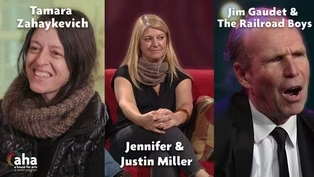
Tamara Zahaykevich explores space, form, and color in her work, which blurs the line between sculpture and painting. What inspired Jennifer and Justin Miller to go from music fans to music venue managers? Watch Jim Gaudet and the Railroad Boys perform "Hey Baby" and more.
Problems playing video? | Closed Captioning Feedback
Problems playing video? | Closed Captioning Feedback
AHA! A House for Arts is a local public television program presented by WMHT
Support provided by M&T Bank, the Leo Cox Beach Philanthropic Foundation, and is also provided by contributors to the WMHT Venture Fund including Chet and Karen Opalka, Robert & Doris...
AHA! | 720
Season 7 Episode 20 | 26m 46sVideo has Closed Captions
Tamara Zahaykevich explores space, form, and color in her work, which blurs the line between sculpture and painting. What inspired Jennifer and Justin Miller to go from music fans to music venue managers? Watch Jim Gaudet and the Railroad Boys perform "Hey Baby" and more.
Problems playing video? | Closed Captioning Feedback
How to Watch AHA! A House for Arts
AHA! A House for Arts is available to stream on pbs.org and the free PBS App, available on iPhone, Apple TV, Android TV, Android smartphones, Amazon Fire TV, Amazon Fire Tablet, Roku, Samsung Smart TV, and Vizio.
Providing Support for PBS.org
Learn Moreabout PBS online sponsorship(bright music) - [Narrator] Transforming discarded materials into fine art, Jennifer and Justin Miller discuss what it's like to own and operate Albany's Lark hall, and catch a performance from Jim Gaudet and the Railroad Boys.
It's all ahead on this episode of AHA!
A House for Arts.
- [Announcer] Funding for AHA has been provided by your contribution and by contributions to the WMHT Venture Fund.
Contributors include the Leo Cox Beach Philanthropic Foundation, Chet and Karen Opalka, Robert and Doris Fischer Malesardi, the Alexander and Marjorie Hover Foundation, and the Robison Family Foundation.
- At M&T Bank, we understand that the vitality of our communities is crucial to our continued success.
That's why we take an active role in our community.
M&T bank is pleased to support WMHT programming that highlights the arts, and we invite you to do the same.
(upbeat music) - Hi, I'm Lara Ayad, and this is AHA!
A House for Arts, a place for all things creative.
Let's see what Matt Rogowicz is up to today.
- I'm here in East Chatham, New York at the studio of Tamara Zahaykevich, who creates what she calls constructions, pieces that blend the worlds of sculpture and painting.
What does that mean?
Follow me.
(peaceful piano music) - I have been making constructions using forms and paint, so I am considered a sculptor that does a lot of painting on top of, or integrated in the work.
I have called them constructions, and that is because there are times in my life when I applied for a sculpture grant, and have been rejected for not being a sculptor, and having too much painting in the work, and applied for things in painting, where they've called me a sculptor, and that, and I didn't qualify for those reasons.
I really didn't want to be an artist.
I didn't think of myself as an artist.
I thought I would be a designer.
I really liked clothes when I was young, and I wanted to do something design-oriented.
I also knew that artists were poor, and I was afraid of that, but I couldn't push against it.
So I found myself in the Rome Program, Tyler School of Art, which is part of Temple University, and there, I got so involved in making art, that I just couldn't look back.
I would do installations, site-specific pieces, when I lived in Philadelphia, and I went to Tyler.
When I moved to New York City, I didn't have many opportunities to make large-scale installations.
I was constantly searching for venues, and it was frustrating to me, because I don't have a strong drawing practice, and I resorted to being a sketchbook artist, and it was very painful for me.
I decided that I would make models of galleries in 19, this was 1998.
I wanted to make models of galleries, and do shows in them.
That was my thought, and it was, I was trying to be funny and conceptual, but the day that I picked up the foam board, and brought it into my tiny, tiny studio, I had this real urge to make something that would be completed in one day.
None of my projects before that could be completed in one day.
So I took a form.
It was actually a piece of styrofoam, and I copied it.
I used tracing paper, and I copied each part, and constructed it, and it was extremely crude, and I just knew that it in itself wasn't anything spectacular, but I knew that there was a road going forward with this kind of making that I was really interested in.
(upbeat music) I'm not interested in sketchbooks, so I don't have a lot of preliminary drawings.
I consider the material that I'm working with, primarily foam board, as a drawing material as well.
So I'm drawing in space.
(upbeat music) What I do is I bend them really easily with my hands, and then I'm able to glue the pieces together, and have these forms, these lines that then you can adjust, and make three-dimensional forms with.
(upbeat music) I'm first-generation American.
My parents are from Ukraine, or I'm of Ukrainian heritage, and my grandmother was quite comfortable until the war.
I've seen people who lose their minds when they lose that kind of comfort, but my grandmother had a resilience, and she became extremely resourceful.
Being able to take something, like a really ugly table, and put a beautiful tablecloth on top to make us feel special, and it was something that impressed me in a way that I wanted to follow her.
And again, not wanting to be an artist, because I was afraid of being poor, I saw it as a way of being able to survive it.
I think about her when I'm working.
I have had her photograph on the wall of my former studio, where I, when I'm struggling, I'll look up and see her there looking down on me, and she's telling me that I can do it, (chuckles) yeah.
I have a real need to alter things, (chuckles) and to give them sort of a chance, give them another life, and I'm not quite sure what that is.
It's almost like I'm anthropomorphizing these things.
I really take it so seriously, what I do, even though at the same time, it's so goofy, what I do, what I make, and some of them are funny, and goofy, but there's, the seriousness of it is in my exploration.
What I'm doing is I'm studying constantly.
- Jennifer and Justin Miller are big music fans who follow their favorite acts across the country.
In 2017, the two joined forces with developer, Jeff Buell, and purchased an old theater building on Lark Street.
After months of renovations, and a few bumps in the road, Lark Hall hosted its first live in-person concert in April of 2021.
What inspired Jen and Justin to go from music mavens to venue managers, and what have they learned along the way?
I sat down with the Millers to find out.
Justin and Jen, welcome to A House for Arts.
It's such a pleasure to have you.
- [Both] Thanks for having us.
- So you've owned and operated Lark Hall in Albany since 2018.
How did this all begin?
What inspired you to purchase this place?
And tell us also what Lark Hall is all about.
- Justin and I are pretty avid music fans.
We do tour a lot around the country.
We follow a few bands.
We have a lot of friends of all over the country that we visit, and see music with, and, you know, we come back to Albany, and you know, there's not much music happening in Albany at the time when we first started talking about this- - And when was that, when were you talking about it?
- Going back, I would say maybe 2015, 2016, like around that time.
- Okay.
- You know, we, you know, there's places that we'd go to, and anytime we could get our hands on live music locally, we would definitely go there.
So we, you know, we came back, we started just kind of joking around about wouldn't it be great if we could bring something to Albany, something on mid-size range, and you know, we started talking about it a little bit more and more, and then it kind of started to come into something more than just conversation, and we started looking at spaces, and we fell onto the building on Lark Street, Lark Hall.
- What is it that you loved about the building?
What inspired you to buy this one in particular?
- Oh, geez, walking in, and it was, it was a building that needed a lot of work.
We knew that, but walking into the space- - 'Cause it's really old, right?
It's from 1916, I think it is?
- 1916, yeah, a lot of history, and just walking in the space has sight lines for anyone, anywhere you stand on the building, and the acoustics, and the sound, we could tell that those core things were there.
It just needed a lot of work, and you know, a lot of love to kind of bring it up to modern times, and equipment in the right way, so we spent a lot of time on that.
- Yeah, and I know, in talking about the two of you, I know that Justin, you were an attorney, and Jen, you have a background with yoga, and kind of holistic health.
Do you think that your backgrounds working in law, and yoga had an impact on what you wanted to do with Lark Hall, and where you think you could see it going?
- Absolutely, yeah.
Jen had been looking for a yoga studio as a potential, as an idea for many years, and we had the music idea for many years, and had looked at a lot of spaces in Albany, and in the capital district as potential ideas, and finding this one, it had kind of everything we were looking for.
It had a space that could be used as a yoga studio, and a space that was an assembly hall, and would be appropriate for a music venue.
So we kind of checked all the boxes and, you know, we've rolled up our sleeves, and tackled a lot of renovations over the last few years.
- Well, I've seen photographs of this building, as well as videos, at least virtually and online.
I can't wait to see it in person, but it looks absolutely beautiful, and a lot of older woodwork, and I know you've kind of set up a bar in there, which is really fantastic, and actually we'll come back to the history of the building in a moment, but I'm curious to know, do you post local bands at Lark Hall?
Like, what's your favorite music?
Do you put some of your favorite genres in there when you're thinking about who to schedule?
- Definitely, we do, you know, we do a mix of local, regional, and national acts, so you know, it's just about kind of fine-tuning what we're doing schedule-wise, and you know, looking out, I mean, right now we're booking out towards close to Halloween, you know, in some instances, but we're doing, you know, a little bit of mix of local music, regional music, national music, but also private events, so we do that.
You know, we love jam band music, so we do book some of that, but the genre of music there is very, you know, that we offer is very diverse, so it's not just what we love, but you know, we know that in order to kind of stay relevant, that we need to host and offer something for everybody.
- Right, something for everybody, and I think community sounds like it's a really important thing for you.
What are some of the most important things that you've both learned about either music, or about owning and running a business?
I know Justin, you've hinted at it a little bit too before, but what are two or three really important things you think you've learned?
- Oh, geez, with respect to the building, there's a lot that goes into renovating older structures in terms of, you know, historic renovations, and learning about how, you know, the building has been an asset on Lark Street, and trying to bring it back, you know, from its old glory, if you will.
It was there for 140 years before we got there, so a lot of the historic renovation stuff, learning about, you know, bringing things up to code, and ADA, and compliance, and fire alarm systems, things like that are something that I, you know, from the beginning, you don't think you're gonna, or at least you don't anticipate having to become kind of a micro expert on, but you do along the way.
So some of those things have been an education along the way, and beneficial, and people kind of kid with me, you know, "You're gonna, that'll be beneficial next time," and I'm like, "No.
(all laughing) "No, we're good, we're good."
- You never wanna deal with that again, right?
- Yeah, and just learning how to, you know, build a bar that looks historic, and things like that.
That's been an education along the way, and Jen's more of the people side of the business.
I'm kind of the what, and she's kind of the how and the who in terms of, you know, booking, and managing staff, and, you know, making the place, you know, what it is now.
- Right, and that's a great point.
So Jen, what are some of these lessons that you've learned about the how and the who?
- Yeah, I mean, there's a lot, you know?
There's so many intricacies behind the scenes of how a show runs effectively, that you just, as a fan, you don't think about, you know?
Because you're sitting there, you're enjoying what's there, but you know, everything has to kind of go off without a hitch, and everybody there has to be a part of that, the band, the sound engineer, the lighting person, the staff, you know, whoever's working with the band to make sure that they get on stage on time, you know, getting them, all the things that they need prior to the show, making sure they show up on time, that they do sound checks.
So it's really, there's a lot of fine tuning that goes into it, and even before they show up, you know, the offers, and the contracts, and you know, just the back and forth, and the marketing is just very, there's a lot that I really just sort of took advantage of, or for granted as a, you know, as a fan, just going enjoying music, but it's a great education, you know?
It's, I didn't think I'd be going back to school at this point in my life, you know?
I was a school counselor for years.
- Okay, so that's like, that's your background?
- Yeah, and so I, you know, this is just, it's fun.
Some days it's hard.
Some days I'm like, "Oh, I'm done with this."
And you know, but there's, you know, like anything, it's just, you know, a rollercoaster, and of love, and sometimes not love.
(chuckling) - (chuckling) Not hate, but non-love, right?
- Right, exactly.
- Yeah.
Well, let's then get to the history of the building itself, because I know that you do a lot of the logistics, and working with people, and making sure everything kind of plans well, and goes out to schedule.
But I understand some incredible things have happened in this building that we now know as Lark Hall.
What are some examples of events that have taken place there, or people who have been there?
- Oh sure, yeah, I'm kind of the history nerd for the building, but yeah, it was built in 1916 by the Daughters of the Eastern Star, which has kind of a Masonic auxiliary, a women's group, and remarkably was built in about six months.
It took us about that amount of time to have our first drawings done for the renovation, but they built the entire thing in about six months, and their first event was for a women's suffragette meeting and convention in New York state, which is kind of cool.
It's history repeating itself.
We didn't get a chance to talk about this before, but being built in 1916, they had a global pandemic in 1918.
- Oh, wow.
- Yeah, so World War I was kind of going at that time, so you know, we bought it in 2018, and had a global pandemic in 2020.
So there's, can I see history repeating.
(Lara laughing) - It's kind of like a strange fate or destiny, I guess?
(all laughing) - It's a strange coincidence, yeah, but really cool history over the years.
It was, the Masonic group had tenants downstairs.
They had a drug store, and an antique store, and a radio and TV hospital there when people actually fixed things.
- Can I talk about it?
- Go ahead.
- And more recently, we had this really, we had a woman reach out who had, you know, reached out on Facebook, and her parents had met there in the late 50s, and they were, they were a part of these, you know, high school kids that would come in and do these, they had dances there, and- - Was it originally a dance studio or something there?
- There was a dance studio for a while, for 40 years prior to us buying the building.
It IBA, it's called IBA.
And so they met there during a dance, and they got married, and, you know, 50 years later, she contacts me and says, "You know, can I bring my parents back?
I want to see what the place they've met."
So we got to host that, which is really special.
- That's wonderful.
I'm sure that was really special for them, and for both of you too.
- It was super cute.
It was special.
- That is really cool.
- We've get a little anecdotal stuff, then a little history bits from time to time.
Andy Rooney met his wife there at a USO dance in the 40s, and I guess Chuck Berry may or may not have been there in the 50s.
- Oh, is that like, a legend or something?
- We know Taj Mahal played there in the mid 80s, so there's a lot of cool history along the way, a lot of cotillions, and you know, kind of things like that back in the 40s and 50s.
- So some really big famous names, famous historical events, like the suffragette movement, as well as these really touching personal stories that unfolded, or kind of had their seed there in this building.
So that's really neat that you're kind of seeing that legacy unfolding in the building.
So let's talk about what we have coming up then for the future.
What are some upcoming events that people have to look forward to at Lark Hall?
- In November, we started a monthly market.
So we do that one Sunday a month, through April.
Our calendar of events is on our website, and we just, you know, like I said, we're booking out bands, you know, into the Halloween, around Halloween at this point.
- Amazing, amazing.
I think that's a sign that you're both doing something right here.
- We're trying.
- I know that it's been a rocky road, but it also sounds like you've learned so much, and you're running such a fantastic place with such a great history.
So thank you so much for giving that to the community, and thank you for being on A House for Arts.
- Thank you.
- Pleasure to have you.
- Thanks.
- Please welcome Jim Gaudet and the Railroad Boys.
- First and foremost, I'd like to thank WMHT for inviting us here to do the AHA show.
We're gonna start off as a tune called Hey Baby.
(playing upbeat bluegrass music) ♪ Hey baby ♪ ♪ Well, it's ash to ash ♪ ♪ Hey baby ♪ ♪ And it's dust to dust ♪ ♪ Hey baby ♪ ♪ Come on, show me a woman ♪ ♪ Hey baby ♪ ♪ That a man can trust ♪ ♪ Like running down the road with my head in my hand ♪ ♪ I'm looking for a woman that'll understand ♪ ♪ Hey baby, hey baby ♪ ♪ Hey baby, hey baby ♪ ♪ Hey, ba, ba, ba, ba, ba, ba, baby, come on ♪ ♪ Come on ♪ (music continues) ♪ Hey, baby, don't laugh now to pieces ♪ ♪ Hey baby, don't shake my tree ♪ ♪ Hey baby, get out of my orchard ♪ ♪ Hey baby, them peaches big ♪ ♪ 'Cause I'm running down the road ♪ ♪ With my head in my hand ♪ ♪ I'm looking for a woman that'll understand ♪ ♪ Hey baby, hey baby ♪ ♪ Hey baby, hey baby ♪ ♪ Hey, ba, ba, ba, ba, ba, ba, baby, come on ♪ Woo-hoo!
(music continues) ♪ Hey baby ♪ ♪ The Hudson river ♪ ♪ Hey baby ♪ ♪ It's cold as ice ♪ ♪ Hey baby ♪ ♪ Jumping in three times ♪ ♪ Hey baby ♪ ♪ Coming up twice ♪ ♪ I'm running down the road with my head in my hand ♪ ♪ I'm looking for a woman that will understand ♪ ♪ Hey baby, hey baby ♪ ♪ Hey baby, hey baby ♪ ♪ Hey, ba, ba, ba, ba, ba, ba, baby, come on ♪ (music continues) ♪ Hey baby ♪ ♪ Well, a man's gotta do ♪ ♪ Hey baby ♪ ♪ What a man's gotta do ♪ ♪ Hey baby ♪ ♪ Get some attention ♪ ♪ Hey baby ♪ ♪ Through with you ♪ ♪ I'm running down the road with my head in my hand ♪ ♪ I'm looking for a woman who'll understand ♪ ♪ Running down the road with my head in my hand ♪ ♪ I'm looking for a woman to understand ♪ ♪ Running down the road with my head in my hand ♪ ♪ I'm looking for a woman to understand ♪ ♪ Hey baby, hey baby ♪ ♪ Hey baby, hey baby ♪ ♪ Hey, ba, ba, ba, ba, ba, ba, baby, come on ♪ All right, well, the next one we'd like to do for you is from our new release, Hillbilly Rock and Roll- - Straight from the Still.
- Thank you, Bobby.
- Thank you.
- And it's called New Girl Now.
(playing upbeat bluegrass music) ♪ Well, I'm born on down in the Redson River ♪ ♪ I told my gal I had something to give her ♪ ♪ Put a ring on her left hand ♪ ♪ She told me I could never ever be her man ♪ ♪ Now, if you don't want me now ♪ ♪ If you don't need me now ♪ ♪ If you don't love me, what do I have left to lose ♪ (music continues) ♪ I could see every dude in this place ♪ ♪ But I ain't never shot down a man ♪ ♪ Slap on the back, slap in the face ♪ ♪ You'll never find a man who can take my place ♪ ♪ Now, if you don't want me now ♪ ♪ If you don't need me now ♪ ♪ If you don't love me, what do I have left to lose ♪ (music continues) ♪ Had a little tantrum at the liquor store ♪ ♪ Smashed whiskey bottles all over the floor ♪ ♪ Helped the clerk clean up the mess ♪ ♪ I took her out to dinner and bought her a new dress ♪ ♪ Now, if you don't want me now ♪ ♪ If you don't need me now ♪ ♪ If you don't love me, what do I have left to lose ♪ (music continues) ♪ So I took a little walk down the old plank road ♪ ♪ Paid back all the money I owed ♪ ♪ I'm so happy she's taken a shine ♪ ♪ I'm all hers so she'll soon be mine ♪ ♪ Now I'm better off now ♪ ♪ All the boys say wow ♪ ♪ Got me a new girl, got me a new girl now ♪ ♪ Got me a new girl now ♪ ♪ Got me a new girl now ♪ ♪ Got me a new girl, got me a new girl ♪ (music concludes) - Thanks for joining us.
For more arts, visit wmht.org/aha, and be sure to connect with WMHT on social.
I'm Lara Ayad.
Thanks for watching.
(upbeat music) - [Announcer] Funding for AHA has been provided by your contribution, and by contributions to the WMHT Venture Fund.
Contributors include the Leo Cox Beach Philanthropic foundation, Chet and Karen Opalka, Robert and Doris Fisher Malesardi, the Alexander and Marjorie Hover Foundation, and the Robison Family foundation.
- At M&T bank, we understand that the vitality of our communities is crucial to our continued success.
That's why we take an active role in our community.
M&T bank is pleased to support WMHT programming that highlights the arts, and we invite you to do the same.
Video has Closed Captions
Preview: S7 Ep20 | 30s | Construction art, Lark Hall & Jim Gaudet and the Railroad Boys perform. (30s)
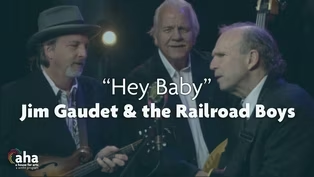
Jim Gaudet and The Railroad Boys - Hey Baby
Video has Closed Captions
Clip: S7 Ep20 | 3m 1s | Watch Jim Gaudet and the Railroad Boys perform "Hey Baby". (3m 1s)
Jim Gaudet and The Railroad Boys - New Girl Now
Video has Closed Captions
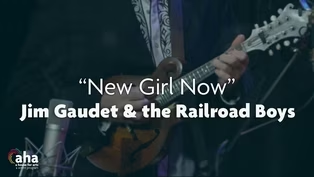
Clip: S7 Ep20 | 2m 33s | Watch Jim Gaudet and the Railroad Boys perform "New Girl Now". (2m 33s)

Turning an Old Theater into a Music Venue, Lark Hall
Video has Closed Captions
Clip: S7 Ep20 | 10m 52s | What inspired Jenn and Justin to go from music mavens to venue managers? (10m 52s)
Providing Support for PBS.org
Learn Moreabout PBS online sponsorship







Support for PBS provided by:
AHA! A House for Arts is a local public television program presented by WMHT
Support provided by M&T Bank, the Leo Cox Beach Philanthropic Foundation, and is also provided by contributors to the WMHT Venture Fund including Chet and Karen Opalka, Robert & Doris...