
WETA Arts September 2022
Season 10 Episode 1 | 26m 31sVideo has Closed Captions
Mosaic Theater’s new leader; Gateway Arts District uncertainty; artist Marta Pérez García.
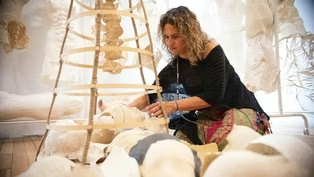
WETA Arts and host Felicia Curry return after a summer hiatus! Meet Reginald L. Douglas, the new artistic director at Mosaic Theater, learn about the challenges facing studio artists in the Gateway Arts District, and check out local artist Marta Pérez García’s installation exploring the troubling yet rarely discussed increase in domestic violence due to stay-at-home orders.
Problems playing video? | Closed Captioning Feedback
Problems playing video? | Closed Captioning Feedback
WETA Arts is a local public television program presented by WETA
WETA Arts September 2022
Season 10 Episode 1 | 26m 31sVideo has Closed Captions
WETA Arts and host Felicia Curry return after a summer hiatus! Meet Reginald L. Douglas, the new artistic director at Mosaic Theater, learn about the challenges facing studio artists in the Gateway Arts District, and check out local artist Marta Pérez García’s installation exploring the troubling yet rarely discussed increase in domestic violence due to stay-at-home orders.
Problems playing video? | Closed Captioning Feedback
How to Watch WETA Arts
WETA Arts is available to stream on pbs.org and the free PBS App, available on iPhone, Apple TV, Android TV, Android smartphones, Amazon Fire TV, Amazon Fire Tablet, Roku, Samsung Smart TV, and Vizio.
Providing Support for PBS.org
Learn Moreabout PBS online sponsorship♪ Hi, everybody.
I'm Felicia Curry, and welcome to "WETA Arts," the place to discover what's going on in the creative and performing arts in and around D.C. On this episode of "WETA Arts"... Mt.
Rainier, Maryland's arts district faces an uncertain future.
Woman: What's at stake is an arts district with possibly very few artists.
Curry: Marta Perez Garcia protests violence against women with life-size paper sculptures.
Garcia: We need to tell the story, we need to scream, we need to do more.
Mosaic Theater's new artistic director Reginald L. Douglas reveals his vision for the theater.
This active engagement between artist and audience around an idea is something we need desperately right now.
All these stories coming up on "WETA Arts."
♪ On Rhode Island Avenue, just past the Washington border, is a 2-mile stretch called the Gateway Arts District.
Here, in Prince George's County, hundreds of artists work in industrial buildings they have adapted to support their work.
There are painters and sculptors, woodworkers and weavers, and artists whose work defies categorization.
Their work may never leave the studio or may end up anywhere from major galleries to public spaces to private collections.
Every so often, the artists invite the public into their work spaces, including ceramicist and studio owner Margaret Boozer.
We're in Mt.
Rainier, Maryland, at Red Dirt Studio.
And today is Open Studio tour.
We are part of the larger whole arts district-wide tour that's going on today.
It's a great day, and the rain is holding off a little bit.
Knock on...plastic.
Curry: If Boozer hadn't forged out on her own and bought this former fire house in 2014, there may not have been a studio to open.
Boozer: Buying this building versus renting let me have security that I wasn't gonna get priced out of the neighborhood, which we were seeing happen on a daily basis here.
It let me have enough artists renting studio space to pay all the costs associated with the building and keep the costs down for artists.
During the pandemic, over half of the artists, at one time or another, needed to take a month off or more, and because of the scale of having 30 artists in the building, I was able to do that, and that feels really important to me.
Curry: Half a mile from Red Dirt Studio, an industrial complex houses dozens more artists' studios, like Otis Street Arts Project, co-founded by David Mordini.
Mordini: Otis Street Arts Project consists of 11 artists, a gallery space, and an event space.
Following the role model of Margaret was our initial ambition.
As things started to get bought and developed, it changed that dream and that focus.
We did go through a substantial rent hike.
We're able to stay here with the limits of what we can do and how we can grow.
Discounted rates helps certain artists stay.
Very inexpensive rent allows people who are graduating from school to get started.
Curry: While some own studios and others rent, John Paradiso manages studios in one of the new high-end apartment buildings coming to the area.
We're at Studio 3807, and we're at Portico Gallery, which is in the building.
We have 5 studios that artists have year leases.
I have studio number 4.
It's about 350 square feet, where I make art.
My position here is to run a gallery and keep the studios filled and the artists happy.
The building does not rely on the studio rents.
It relies on the rest of the rents.
It is a luxury building.
The gallery and studios are an amenity and a feature.
The developer of the building is very happy with the success of Portico Gallery and Studios because he loved the Arts District, and he wanted the things that happened in the Arts District to happen in his building, and they do now.
We have art being made here, shown here, and guests coming to appreciate it.
Curry: The Gateway Arts District coalesced when artists left downtown D.C. as new development forced them out.
Woman: There used to be amazing artist studios downtown-- floor-to-ceiling windows, like, amazing, beautiful spaces-- and those went away overnight.
And all those artists who had this amazing community down there were dispersed to look for other spaces, and studios really started filling up out here.
Curry: But now some are concerned that luxury development will force artists to move again.
The studio spaces that are offered in Mt.
Rainier are so crucial to artists in the region, especially as prices rise.
Some artists are having to move further and further out of the District.
And so to have a place like this, it's really crucial to the whole visual arts ecosystem in the region.
Curry: What does that ecosystem look like?
At Otis Street Arts Project, it looks like a warren of studios where members gather informally in each other's spaces.
Chris Combs was seeking studio space when he first encountered Otis Street Arts Project through an Open Studio event.
I picked you all because it seems to me like you had a very good community that was strong and excellent at kind of working off of each other's strengths.
Cause it feels like having your own art Google or something.
And having reflections back on how your art is developing and what you're up to is super-important to me in a studio.
I was at Red Dirt Studios before with Margaret Boozer in the incubator program that she runs.
And then you get shepherded on, and Otis Street felt like it was a really nice segue.
Curry: The Red Dirt Studio experience is more structured than at Otis Street.
We call it seminar.
We meet once a week.
We do business of art, critical feedback, What are you working on?
What am I working on?
How can we help each other out?
It's a mentorship.
Our values go beyond just the feedback on what artists are working on in-studio to what they're trying to do in their lives.
It's really not a place to just store your tools.
I came to seminar, and I met Margaret.
And the energy I got from this place is just like family.
It's positive, and it's diverse.
I see different faces, different colors.
And Margaret just has taught me so much, which is more than painting.
When I come here, it's like a-- it's like a weight off my shoulders.
You know, it's like, I'm in the right place.
It's like a church, a sanctuary, you know.
Just to come back to this area and be able to access the kind of support that I need has been fantastic.
Man: My work is to present my story as an undocumented immigrant.
Yesterday, just yesterday, after 9 years, I received my green card, so I'm so grateful-- Woman: Whoo-hoo!
[Clapping] And so it's effort from right there.
They did so much work to help me with this, so I'm grateful.
Curry: Open Studio Day brings out curators, critics, patrons, and concerns for the future of the Gateway Arts District.
Boozer: What's at stake is without artists owning their own space, we are gonna have an Arts District with possibly very few artists in it.
We're banking on the goodwill of the people that own the buildings who are allowing the artists to be there who think that that is cool and a good idea, but that's really not something you can bank on forever.
I think that there's a limited amount of spaces that can become studios.
With the development that's happening, we have to try to influence the developers to keep an art component.
It is a community effort, and we have to be vigilant and keep an eye on how the development is going.
We often get tours through here from other cities who are trying to re-create an Arts District.
And I tell them, you can't create an Arts District.
An Arts District is organically grown by artists who seek out inexpensive rent and build a special community.
That's what keeps it from being so sterile.
[People cheering] Boozer: I have a lot of hope in the Gateway Arts District coming together and realizing that they need to put some energy into this.
It's almost too late, but it's not too late.
If we don't move to secure these spaces, then we're gonna lose these artists.
They're gonna go wherever there's cheaper space.
They're gonna keep moving.
You can meet the artists of Otis Street Arts Project at an Open Studio on Saturday, October 22nd from 12-5pm.
Red Dirt Studio is having an Open Studio November 13th, 1-4pm.
Portico will host a solo show for artist Tom Hill.
The show is called "Unnatural Desire in Natural Settings."
It will run September 10th through October 29th.
The gallery is open on Saturdays, noon to 3:00 and by appointment.
Check their websites for details.
Duncan Phillips, founder of The Phillips Collection in Dupont Circle referred to his museum as an experiment station for contemporary art.
The Phillips is honoring that charter through an initiative called "Intersections," which invites working artists to respond to spaces and art in the museum.
One of these responses is an installation by local artist Marta Perez Garcia called "Restos - Traces."
Garcia: I'm an artist originally from Puerto Rico.
I been living in D.C. since 2008.
I'm a [indistinct] maker as well as sculptural, and I've been working lately with installations, and my theme mostly has been around gender bias.
I'm from a small town, Arecibo, an hour from San Juan.
My parents didn't let me go out too much at certain times.
You hear all these stories about how many womens have been killed.
In 2018, when Hurricane Maria hit, the cases of murder of womens through violence double.
For us, to be inside is to be safe.
But for these women, to be inside, is to be with their aggressor.
So I wanted to represent in these works the women that are not here anymore, that don't have a voice anymore, but they have a name.
You have to remember their name.
You have to remember that they were here and what--and what happened to them.
Curry: The installation "Restos - Traces" is not Garcia's first appearance at the Phillips.
Well, Marta was included in our summer exhibition "Inside Outside," an exhibition by invitation offered to all the artists living in DMV area.
Garcia: This is made with handmade paper to make the form of the hand, then I wrote in the upper part in Español "Tu mano la misma que una vez me acaricio ahora me arrebató la vida."
"This hand, at one time, used to caress me is the one that kill me."
So, Vesela came to the studio because they decided to buy the piece, which I was just in the moon for that.
She saw it touched us, and she was very helpful talking about it.
What can I say?
It was sort of love at first sight.
The work really struck me.
And spine is the connecting element to them as a symbol of resilience and stamina and--and power.
Garcia: The first thing I did was a spine.
I asked these womens what does it mean to you, the spine?
They always did this... And they say "Strength."
From the spine, I went to the body.
And I did it without a head because I wanted people to see themselves in these torsos.
♪ I created these bodies with wire.
I use clay.
I use different papers, 'cause papers have different strengths and different colors.
♪ I use hair that I mix with the paper.
I did a lot of molds.
I use teeth in a lot of my work.
♪ This body of work by Marta is very different what we had in our exhibition and was the first time that she actually started to work on this scale.
It was very interesting when Vesela came to the studio.
I remember Vesela telling me, "They're beautiful."
And I look at her, and she said, "They're very strong.
They're beautiful at the same times."
I was so inside the work, I couldn't see that.
Curry: Each torso reflects a real story of violence against a woman.
Garcia: This torso was a really, really sad story that happen in Puerto Rico about this really young woman.
And she got pregnant and she got killed because of that.
The part of the dress that almost looks like a wedding dress is made with the same material you do the baskets.
The faces that are screaming-- I think, for me, screaming is just not the scream of the pain, but we need to tell the story.
We need to scream.
We need to do more.
I think it was one of the most difficult ones to do.
I burned my fingers, I mean, like, really bad, but it's amazing when you're doing something and you're so into it, it doesn't matter.
You just keep creating.
♪ In some of these torsos, I work with words.
I was thinking about the trans women and the invisibility that they have and how hard it is for them when they in a violent relationship to look for help and to be taken seriously.
The level of suspensions was very important because the basic idea was to create an experience where viewers can walk through and be at the same height as you would be to a living body.
♪ "Restos - Traces" fits in the "Intersections" series because it engages the architecture of this particular gallery because of its height, which is 18 feet high.
Really gave enough space to the bodies.
This is the last piece that I did.
I wanted to do a torso that was standing up.
This torso--it looks more like a younger kid.
And I think, for me, it's important that people understand that in all of this violence are not just against womens but it's against young kids, too.
I think the only one that has a heart.
You have a heart, you have a life.
You have a story.
You're somebody, you know?
♪ Sretenovic: What's the most powerful to the work for me, it's the unspoken and the silence and the invisible that those bodies carry.
These womens have a name.
These womens have a story.
They have kids.
They have a family.
And I think sometimes we forget about that.
So, this installation was really for people to reflect and to really understand that this womens are human beings like us and that they have stories like us.
♪ Marta Perez Garcia's next local exhibition is called "Rotura Rupture" and features her color woodcut prints.
The exhibit is at the Cade Center for the Arts Gallery at Anne Arundel Community College.
It runs from October 11th through November 20th.
The "Restos - Traces" exhibition at the Phillips has moved on, but keep an eye on Garcia's website to find out when and where you can see it next.
Director, producer, and dramaturg Reginald L. Douglas is someone I know as Reg, because I've worked with him.
In fact, I was an actor in his directorial debut at Studio Theater of a play called "Until the Flood" about the 2014 shooting of Michael Brown.
If someone can carry out the law, then that's a good thing.
In 2021, Mosaic Theater selected Douglas as its new Artistic Director after a nationwide search.
We met him at Atlas Theater on H Street Northeast, where Mosaic is a resident theater company, to talk about his vision and hopes for the theater.
Reg, welcome to "WETA Arts."
I cannot tell you how excited I am to have the opportunity to sit and chat with you, my friend.
This is unbelievable.
I can't believe I'm here.
Thank you so much for doing this.
Coming to Mosaic Theater is really a homecoming for you of sorts.
Tell me what brought you here to D.C. in the first place.
Oh, my gosh.
So, the original dream was K Street.
I wanted to be a lobbyist.
I wanted to fight for education reform and community development, and I got to live my dreams out at Georgetown University.
I studied politics and African-American Studies and English, all with a dream of being a lobbyist working on the Hill.
I got to work for then Minority Leader Pelosi.
I got to work for the Alliance for Excellent Education.
I was living the political kid's dream, and I hated it.
Ha ha!
It just wasn't personal enough for me.
I wanted to really know the names behind the data.
So, I took a political theater course with Dr. Derek Goldman at the theater program at Georgetown, and everything changed.
I realized, oh, I could combine my love of civic engagement with my love of arts.
As a director, what are some of the favorite projects that--that you've worked on?
Oh, my gosh.
"Oklahoma!"
at Weston Playhouse.
I was like, "Really?
Me?
'Oklahoma!'?"
But I love musicals.
I love being able to revisit a classic.
Again, with that spirit of inquiry, why is he named Curly?
Why is Laurie in love with him?
What if?
And we centered a gorgeous racial utopia in that production, creating a community-- all races and body types, sexualities-- all sharing the stage in this joyful celebration of America.
Everything was good until the black Curly killed a white Jud and put his hands up.
We have to present the fullness of our truth, and to do that with a classic musical like "Oklahoma!"
where I found out I was the first black man to direct that show, what a gift, what a gift.
And to do it in Vermont, just what a gift at how theater can connect over boundaries and barriers and differences.
Tell me a little bit about developing new plays.
I know that's something that you did right after graduation.
I went to New York, where I'm originally from.
I had amazing fellowships at the Lark, at New York Theatre Workshop, was Assistant Directing off-Broadway, and I was getting access to different playwrights-- emerging, established, as they tried new ideas.
And so I realize, "Huh.
What these writers are doing "is shaping the next canon of the American theater, "and I want a part of that.
"I want to be a part of telling the story "of what it means to be alive right now "so that some next generation of Reggies and Felicias "could read those plays, understand what this moment meant to playwrights, to audiences, and be inspired to make their own new work."
And is this what sparked the desire to transition from Director to Artistic Director?
I was Assistant Directing at a big nationally recognized theater company, and it was a new play.
And first rehearsals are so much fun.
The whole staff comes, the board comes, all the artists are in the room, and I'm looking at this behemoth institution, and I see about 3 or 4 people of color in the whole room.
And I realize, yes, I can be a director, but I could also help direct our industry.
By taking a seat behind the table and giving that opportunity to more people who look like me and you.
The greatest highlight of my job is I get to tell artists "You matter.
"Here's a paycheck.
Here's space to work, to try out your ideas."
I get to extend welcomes to people every day and say, "Come join us.
Come see a play that reflects who you are "and what our world could be with you in it.
See yourself onstage."
The official name of that park is Meridian Hill Park, but all the cool people called it... Malcolm X Park.
It is the greatest gift to be able to be in this seat to give other people their seats and their opportunities.
Political theater and theater that activates, that sparks conversations, that speaks to the diversity of our world, it's become my life.
And to now live out that dream, that mosaic, it's like the ultimate full circle.
We are in the midst of the inaugural season of Reg Douglas here at Mosaic Theater.
What can we expect?
"The Till Trilogy" by Ifa Bayeza, which kicks off our season.
We're so honored to be presenting this world premiere-- 3 plays in rotating repertory.
10 dynamic actors taking on these iconic works about the life, death, and legacy of Emmett Till.
It is a tour-de-force opportunity for theater artists but also for audiences, and we're really excited to center black history and American history in this way.
I'm really excited about "Bars and Measures."
It'll be my Mosaic directorial debut.
"Bars and Measures" centers on two brothers-- one Christian, one Muslim.
one a jazz musician, one a classical musician, one in jail, one not.
And it centers on the fact-- and I really believe this-- that music is just like love.
It is more powerful than any barriers that the world tries to create.
We have a New Play Festival kicking off, new play development workshops, like "Mexodus" and "Murdered Men do Bleed and Drip."
Two "What If?"
new play readings, you know?
We get in a room for 5 hours, and we come out with a new draft full of Post-Its and red pen.
New work has been a core of my career.
I can't wait to welcome local D.C. writers and acclaimed national writers to the DMV to work with our community, to work with our actors, our directors, our dramaturgs, on new work in development and then share it with audiences at all stages.
So, a lot to look forward to at Mosaic.
What do you say to the D.C. theatergoers, who are hesitant, maybe, to come back into the theater, especially when you're doing new works or you're talking about things that hit on a little bit of trauma?
What do you say to those theatergoers to bring them in?
I think my job is to make the safest and bravest space we can.
We are proud to be hiring D.C. talent to make D.C. stories, but we need our audience to come back and come join us in that party.
It's gonna be a joyful season.
It's gonna be a fun season.
It's gonna challenge you, but it's also gonna make you feel good.
What were the challenges for you to produce the type of work that you're trying to produce as a black man, and how has that helped you figure out how you will run your theater here in D.C.?
Loneliness is real.
It's not easy sometimes to be the only one in the room, but you gotta remember why you're doing it.
I'm interested in an active engagement with my collaborators and with an audience as a collaborator.
It's not about me.
It's ultimately about those 150, those 350. those 1,000 people in the audience who receive that story and hopefully walk out that theater feeling empowered, feeling seen, feeling valued.
The "why" is so that some young Reggie in that audience can see his dream as valuable and valid.
Reg, I want to say thank you for being here with us today on "WETA Arts," and thank you for choosing the D.C. theater community.
I'm so blessed to be here.
I am so grateful to Mosaic, to D.C., and to you for doing this.
This is a dream come true.
You can see all 3 plays in Ifa Bayeza's "The Till Trilogy" October 7th through November 20th.
It's accompanied by "The Till Trilogy Reflection Series," events related to the play's themes of black history, justice, and activism.
Also, keep an eye out for Mosaic's upcoming New Play Festival.
Check the website for details.
Here's a thought from Jeff Tweedy, singer and guitarist of the band Wilco.
"I think that may be the highest purpose "of any work of art-- to inspire someone else to save themselves through art."
Creating creates creators."
Thank you for watching this episode of WETA Arts.
Be well, be creative, and enjoy the art all around you.
I'm Felicia Curry.
Announcer: For more about the artists and institutions featured in this episode, go to weta.org/arts.
♪
Preview: WETA Arts September 2022
Preview: S10 Ep1 | 30s | Mosaic Theater’s new leader; Gateway Arts District uncertainty; artist Marta Pérez García. (30s)
Providing Support for PBS.org
Learn Moreabout PBS online sponsorship

- Arts and Music
The Best of the Joy of Painting with Bob Ross
A pop icon, Bob Ross offers soothing words of wisdom as he paints captivating landscapes.













Support for PBS provided by:
WETA Arts is a local public television program presented by WETA