
March 3, 2026 - PBS News Hour full episode
3/3/2026 | 57m 46sVideo has Closed Captions
March 3, 2026 - PBS News Hour full episode
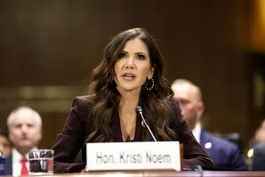
Tuesday on the News Hour, the U.S. escalates attacks on Iran as Americans scramble to evacuate from the region. We speak with the top Democrat on the Senate Intelligence Committee, and with President Trump's former national security advisor, John Bolton. Plus, Homeland Security Secretary Kristi Noem faces congressional scrutiny over the killing of two American citizens by immigration agents.
Problems playing video? | Closed Captioning Feedback
Problems playing video? | Closed Captioning Feedback
Major corporate funding for the PBS News Hour is provided by BDO, BNSF, Consumer Cellular, American Cruise Lines, and Raymond James. Funding for the PBS NewsHour Weekend is provided by...
Support provided by:

March 3, 2026 - PBS News Hour full episode
3/3/2026 | 57m 46sVideo has Closed Captions
Tuesday on the News Hour, the U.S. escalates attacks on Iran as Americans scramble to evacuate from the region. We speak with the top Democrat on the Senate Intelligence Committee, and with President Trump's former national security advisor, John Bolton. Plus, Homeland Security Secretary Kristi Noem faces congressional scrutiny over the killing of two American citizens by immigration agents.
Problems playing video? | Closed Captioning Feedback
How to Watch PBS News Hour
PBS News Hour is available to stream on pbs.org and the free PBS App, available on iPhone, Apple TV, Android TV, Android smartphones, Amazon Fire TV, Amazon Fire Tablet, Roku, Samsung Smart TV, and Vizio.
Providing Support for PBS.org
Learn Moreabout PBS online sponsorshipAMNA NAWAZ: Good evening.
I'm Amna Nawaz.
GEOFF BENNETT: And I'm Geoff Bennett.
On the "News Hour" tonight: The U.S.
escalates attacks on Iran, as Americans scramble to evacuate from the region.
JANICE JACOBS, Former U.S.
Assistant Secretary for Consular Affairs: It is a challenge, no question about it, because airports are closed, airspace is closed.
AMNA NAWAZ: Congress prepares for a war powers vote to limit President Trump's military authority.
We speak with the top Democrat on the Senate Intelligence Committee and with Trump's former National Security Adviser John Bolton.
GEOFF BENNETT: And Homeland Security Secretary Kristi Noem faces congressional scrutiny over the killing of two American citizens by immigration agents.
(BREAK) GEOFF BENNETT: Welcome to the "News Hour" on this day four of the American-Israeli war with Iran.
And while U.S.
and Israeli jets continue their punishing attacks inside Iran, the Islamic Republic has widened its targets throughout the Arab states of the Gulf and against Israel.
AMNA NAWAZ: American diplomatic targets in the Gulf were hit overnight, and almost all the civilian airspace throughout the region remains closed.
The U.S.
State Department, after telling hundreds of thousands of Americans to leave of their own accord and on their own, reversed course today and said the U.S.
is working to provide military and charter flights to evacuate Americans wishing to leave.
All the while, the death toll from the American-Israeli bombardment mounted inside Iran.
Nick Schifrin again begins our coverage.
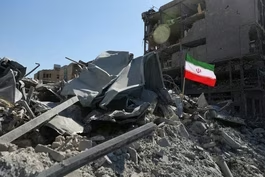
NICK SCHIFRIN: In Tehran, the iconic Freedom Square engulfed in war.
Rescue workers responded to an apparent Israeli airstrike that left cars charred and pedestrians stunned.
And jets targeted what remains of Iran's leadership.
This building housing a regime advisory council was flattened.
Just to the south in Qom, an Israeli official confirms it targeted a meeting of senior clerics choosing the next supreme leader.
Iranian state media claim those clerics are all safe.
But, tonight, Israel says it also struck what it called a -- quote -- "secret nuclear headquarters," where Israel says Iran had shifted its nuclear infrastructure after it had been struck by the United States last summer.
Across the capital, explosions sparked defiance.
SAYED ABBAS HOSSEINI, Tehran Resident (through translator): The Americans think they can force us to surrender with missiles and so on, but they can't do such wrong things.
We will certainly defeat them.
NICK SCHIFRIN: And pain.
WOMAN (through translator): They killed all of my people.
They dropped bombs.
They hit us again.
They killed people's children.
NICK SCHIFRIN: Many children today were laid to rest, one with their backpack still on.
Iran says a strike killed more than 100 mostly schoolchildren.
The U.S.
says it's investigating.
But the war is spreading.
Israel pounded Beirut, targeting the senior leadership of Iranian ally Hezbollah.
Commercial airplanes are still taking off, even though one flew into the smoky sky.
Israel also deployed troops into Southern Lebanon IN what an IDF official said was not deep, but spread widely.
They're responding to Hezbollah rockets and a warning today of -- quote -- "all-out war."
Today, thousands of Lebanese families filled roads away from the Israeli border fleeing a war they didn't sign up for.
But Iran is resisting this Israeli-American war by targeting American soil in the region.
Today, U.S.
officials set an Iranian drone struck the parking lot next to the Dubai consulate's main building.
Nobody was injured.
But this Iranian drone attack follows another one overnight on the embassy in Riyadh and an attack on Sunday on the embassy in Kuwait.
MARCO RUBIO, U.S.
Secretary of State: Our embassies and our diplomatic facilities are under direct attack from a terroristic regime.
NICK SCHIFRIN: Today on Capitol Hill, Secretary of State Marco Rubio urged all Americans across the region to leave as quickly as possible.
MARCO RUBIO: We have identified and continue to identify charter flights, military flight options and expanded commercial flight options, meaning working with the airlines to send bigger airplanes with more seats.
NICK SCHIFRIN: Last night, the State Department told Americans across 14 countries to evacuate immediately.
A U.S.
official says that includes more than a million people; 9,000 Americans have managed to leave the region alongside Europeans relieved to be back home.
ALEXANDER GOGA, Passenger Returning From Dubai: You hear the bombings or them stopping the bombing, and, I mean, it's really, really strange.
I mean, it's not a nice situation and environment to be in at all.
MARCO RUBIO: The challenge we are facing is airspace closures.
If a country closes their airport - - for example, in some cases, the airports have been hit.
So the airport in Kuwait was hit.
So if an airport's been attacked or the airspace is closed, then we can have the planes lined up to go, but we can't get them to land because we don't have the permissions to land there.
JANICE JACOBS, Former U.S.
Assistant Secretary for Consular Affairs: If it's not unprecedented, it is unusual in its scope.
NICK SCHIFRIN: Ambassador Janice Jacobs had a more-than-30-year career in the State Department and was President Obama's most senior State Department official in charge of helping Americans overseas.
JANICE JACOBS: I think the first advice was to tell people to shelter in place.
Now we're telling them to leave.
It is a challenge, no question about it, because airports are closed, airspace is closed.
QUESTION: Why wasn't there an evacuation plan and will you send planes to get people out?
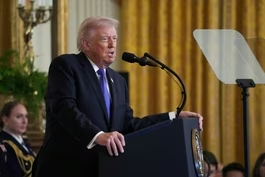
DONALD TRUMP, President of the United States: Well, because it happened all very quickly.
We thought and I thought maybe more so than most -- I could ask Marco -- but I thought we were going to have a situation where we were going to be attacked.
NICK SCHIFRIN: Today, President Trump tied the evacuations to his argument that he had no choice when to start the war.
DONALD TRUMP: You see, We Were having negotiations with these lunatics.
And it was my opinion that they were going to attack first.
They were going to attack.
If we didn't do it, they were going to attack first.
I felt strongly about that.
NICK SCHIFRIN: The war has challenged the U.S.'
ability to deploy enough missiles to intercept Iranian drones and missiles across a dozen countries and enough munitions to wage a war the president said was planned to last about a month.
But U.S.
officials say the war has entered a new phase and they can now use weapons that are more plentiful, leading to President Trump last night to write: "We have a virtually unlimited supply of these weapons.
Wars can be fought forever and very successfully using just these supplies."
That is a stunning reversal to first-term Donald Trump.
DONALD TRUMP: I campaigned in ending the endless wars.
We're all over the world fighting wars.
Half the places, nobody even knows what they're doing over there.
But really the plan is to get out of endless wars, to bring our soldiers back home, to not be policing agents all over the world.
We will keep America out of foolish, stupid, ridiculous foreign wars.
NICK SCHIFRIN: But the U.S.
is warning tonight this foreign war will last as long as necessary.
GEOFF BENNETT: Nick Schifrin joins us now along with White House correspondent Liz Landers.
Good to see you both.
Liz, we will start with you.
President Trump met with the German chancellor today at the White House.
We saw him take questions from reporters.
One of the questions he got was, who could lead Iran next?
What did he say?
LIZ LANDERS: This was the first time we have heard the president take questions from the press on camera since this strike was launched over the weekend.
And now that the supreme leader has been killed, there's a question of who's going to lead the country.
He was specifically asked today in that Oval Office meeting about whether or not the crowned prince, Reza Pahlavi, the exiled crown prince, the son of the former shah of Iran, could lead the country.
Here's what he said.
DONALD TRUMP: It would seem to me that somebody from within maybe would be more appropriate.
I have said that.
He looks like a very nice person.
But it would seem to me that somebody that's there, that's currently popular, if there's such a person, but we have people like that.
LIZ LANDERS: But the president has also said that many of the other options that the administration was looking towards as potential successors in Iran have also been killed now.
We heard yesterday from the secretary of war, Pete Hegseth, that this is not a regime change war, so still questions about who succeeds there in Iran.
GEOFF BENNETT: And, Nick, you reported that Israel struck the meeting of the assembly that is picking the next supreme leader in Iran.
What more do you know?
NICK SCHIFRIN: Well, as you and Liz have been discussing, this is a real key decision point for the future of the Islamic Republic.
And there are reports tonight, we haven't confirmed them, but there are reports that assembly has chosen Mojtaba Khamenei.
He is the son of the current supreme leader.
And if this is true, if this is the case that he's been chosen, this is not in U.S.
interests.
Analysts tell me that he represents a continuation of his father's policies backed by hard-liners within the Islamic Revolutionary Guard Corps, with whom he fought in the trenches of Iran's war with Iraq.
That said, analysts do tell me that he's probably in the best position to consolidate power at this point.
Among the other candidates being considered, Hassan Khomeini, the former supreme leader's grandson, considered a relative moderate.
You see him there on the right.
And Alireza Arafi, considered a hard-liner.
But as Liz pointed out, many of the other moderate candidates were killed in that first Israeli airstrike.
GEOFF BENNETT: And, Nick, the secretary of state, Marco Rubio, who we saw in your piece taking questions there from reporters, he sought to explain, clarify his comments yesterday about Israel and the start of this war.
Fill us in.
NICK SCHIFRIN: So, yesterday, Secretary Rubio really suggested that the U.S.
hand had been forced by Israeli decision to go in regardless of what the U.S.
did.
Today, echoing President Trump, he removed Israel from that equation.
So listen to what he said yesterday first, and then today.
MARCO RUBIO: We knew that there was going to be an Israeli action.
We knew that would precipitate an attack against American forces.
And we knew that if we didn't preemptively go after them before they launched those attacks, we would suffer higher casualties and perhaps even higher those killed.
Once the president made a decision that negotiations were not going to work, that they were playing us on the negotiations and that this was a threat that was untenable, the decision was made to strike them.
NICK SCHIFRIN: Again, removing Israeli decision from the U.S.
decision to go to war, as the president say -- but a reminder, Geoff, as we have been talking about, it was the U.S.
that provided Israel the intelligence that allowed Israel to start this war with that initial attack that killed the supreme leader.
GEOFF BENNETT: And, Liz, let's talk more about the politics of this, the domestic politics, namely the pushback from parts of President Trump's MAGA base.
LIZ LANDERS: Yes, so, yesterday, we saw that the White House is putting out allies and officials, including Vice President J.D.
Vance, who was on FOX News last night, pushing back on some of this MAGA opposition.
However, we're still seeing some of these high-profile conservative voices speaking out against this military action, including Megyn Kelly, the former FOX News host who has a very popular YouTube show.
She said that Americans shouldn't die for a foreign country and placed blame for this conflict on Israel.
But the president himself actually hit back on some of these doubters in a phone interview that he did with the journalist Rachael Bade.
He said of Megyn Kelly, he said: "She ought to study her history book a little bit."
He also responded to Tucker Carlson's criticism of him, saying that "He has no impact on me."
And he also talked about MAGA writ large.
He said: "MAGA is Trump himself.
It's not the other two," talking about Kelly and Carlson.
I also asked the White House too about former Congresswoman Marjorie Taylor Greene, who's been very vocal about this in the last few days.
They sent me a statement saying" "Former Congresswoman Greene quit on her constituents and the America first movement in the middle of her term.
President Trump is fighting every single day to make America great again.
We don't have time for."
That's from Davis Ingle, a White House spokesperson.
One source who's close to the White House I spoke to earlier today on the phone said that the whole messaging around this is -- seems like the president is message-testing through the media.
This person described it as the president conducting a focus group of 350 million people that is playing out through the press, Geoff.
GEOFF BENNETT: OK.
Liz Landers, Nick Schifrin, our thanks to you both.
NICK SCHIFRIN: Thank you.
AMNA NAWAZ: Let's turn now to our special correspondent in Tehran, Reza Sayah.
Reza, more airstrikes on this now fourth day of war.
Tell us about what you saw today.
REZA SAYAH: Yes, just another intense, unnerving, frightening day of airstrikes here in the capital, Tehran.
And it just continues to be an astonishing scene, seeing these jet fighters, hearing them zoom ahead and then hearing these earth-shaking explosions followed by thick plumes of smoke, the most intense air raids taking place overnight from about midnight to 2:00 a.m.
Then it was a quiet morning, and then, during the afternoon hours in broad daylight, more airstrikes.
AMNA NAWAZ: Meanwhile, we have seen Iranian state TV has been reporting that funeral and burial plans for the late supreme leader the Ayatollah Khamenei are now under way.
What more can you tell us about that?
REZA SAYAH: Yes, Iranian officials say they're planning for it, but few other details.
They say there's going to be a ceremony here in Tehran and they say the late supreme leader is going to be buried in his hometown of Mashhad in the shrine of Imam Reza.
And, obviously, this is going to pose a huge challenge for the establishment, for the government.
They want to project stability and continuation.
They want to honor the supreme leader, a spiritual leader that to them died an ideal death, being martyred in the month of Ramadan at the hands of the very same countries that he preached against.
So they see this as an opportunity to energize their base, but obviously this is a country that's under attack, being bombed every day.
How are they going to plan this?
How are they going to execute it?
We will wait and see.
AMNA NAWAZ: Reza, as you know, and we have spoken about, when he first announced the U.S.
and Israeli strikes, President Trump called for the Iranian people to -- quote, unquote -- "seize control of your destiny," essentially calling for regime change.
And in the days since, we have seen some videos, some reports of people celebrating in the streets and toppling monuments.
Are you seeing any indication of a larger protest brewing?
REZA SAYAH: At this point, we're not.
Obviously when the death of the supreme leader was announced, there were pockets of celebrations throughout the country.
But millions of others came out to mourn his death.
The bottom line is, Iran is a country of 90 million people.
These are 90 million voices.
Are there many people among this population that didn't like the supreme leader, that despised him?
Indeed, there are.
But there's also millions of people that despise the United States and Israel more, especially with this war.
And there's other Iranians who are simply confused.
They feel helpless.
They feel under attack and they want some stability.
So that's the indication of this uncertainty that exists right now.
Again, at this point, no sign of any mass protests, mass uprising and no indication of an organized opposition with a clear leader.
If in the coming days, it so happens that people come out, it is very likely that armed security forces are going to be waiting for them.
They're aware of that possibility.
AMNA NAWAZ: That's our special correspondent in Tehran, Reza Sayah, reporting tonight.
Reza, thank you.
REZA SAYAH: Thank you, Amna.
AMNA NAWAZ: Trump administration officials briefed members of Congress today on the war with Iran.
That's as both chambers gear up to vote on a War Powers Act that could limit President Trump's authority in carrying out strikes.
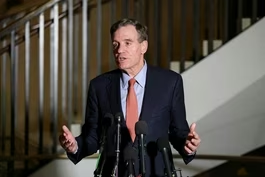
To discuss that, I'm joined by Senator Mark Warner of Virginia.
He is the top Democrat on the Senate Intelligence Committee.
Senator Warner, welcome back to the "News Hour."
Thanks for being with us.
SEN.
MARK WARNER (D-VA): Thank you so much.
AMNA NAWAZ: So you were briefed today with all the other senators, yesterday as part of a smaller group in the Gang of Eight.
Were you given any evidence in either of those briefings that showed Iran was an imminent threat to the U.S., to U.S.
military assets in the region, or to U.S.
allies?
SEN.
MARK WARNER: Absolutely not.
This is a war of choice brought by Donald Trump.
In many ways, and I say this is a strong supporter of Israel, the timing of this war was dictated by Bibi Netanyahu.
And while I support Israel, I think at the end of the day, when American interests were at stake, when we have lost six soldiers at this point, we have to show the direct support and immediate risks to America.
That was not the case.
And we have seen now over the last week or so, and I have been in every one of the classified briefings, there have been now four reasons given for why this war was started.
One was to take out Iran's nuclear capabilities that the president claimed was eliminated nine months ago.
Then it was moved to the ballistic missiles, which was a rising threat against American bases in Israel, but not imminent.
Yesterday, we even heard an answer about getting rid of the Iranian navy.
We have never heard that before.
And then we have heard from the president regime change.
And, as your prior reporter indicated, Iran's a complicated company of -- a country of 92 million people.
If the president has called upon the Iranian people to rise up, and let's say in a few days 100,000 Iranian protesters go to the street and the Iranian military kills 5,000, 10,000, 20,000, does the United States have any obligation to do anything?
So we are in a war of choice where we don't know what success will be viewed as, and we don't know what the next steps will be.
AMNA NAWAZ: Let me ask you more about the protesters in just a moment.
But in terms of the long-term goal here we have heard articulated in various forms by the administration, if it is to prevent a nuclear-armed Iran, a regime that is hostile to the U.S.
and hostile to its allies, hostile to its own people, as you mentioned, the tens of thousands protesters is killed, is that a goal that is worth it in the long run to try to take out this regime?
SEN.
MARK WARNER: Well, I had -- I shed no tears for the death of the supreme leader and the Iranian leadership, who have American blood and other blood on their hands.
But the thing is, if the president had chosen to try to take an action like this in January, when the Iranian people were on the streets by the millions, I would have been more sympathetic or at least listened to his case.
He couldn't do it at that point for two reasons.
One, the military capability that we needed in the region, the aircraft carrier the Ford that is home-ported in Norfolk, Virginia, was off the coast of Venezuela on another one of his military follies.
And then the ability to have our European allies help us, who also don't want Iran to have a nuclear capability, they were occupied because of Trump's, I think, folly of trying to go after Greenland.
So he chose -- he couldn't act then.
He's now built up these forces for months on end, acted not because of an immediate threat, but in concert with our ally Israel, which is an ally.
But if they had all this time to plan, where in the heck are the plans to get rid of the literally hundreds of thousands of Americans who are now caught in a war zone with no way out?
AMNA NAWAZ: Senator, if I may, part of the reasoning we heard today from the administration was that this is an Iran that was weakened in a way that it wasn't before and that was part of the timing, they say.
But, to your point, if we are where we are now, if people in Iran do take to the streets, will and should the U.S.
support them in a way that they haven't before?
What would you like to see happen now?
SEN.
MARK WARNER: Well, let me answer your first question.
Iran is weakened.
And that is a good sign.
But Iran was not going to be stronger a month from now if those negotiations were to appear that there might have been some breakthroughs.
Why not let the negotiations follow through a little bit?
Then we could have maybe rallied more of the world to our side if Iran was not willing to make concessions.
AMNA NAWAZ: But should the U.S.
support protesters now?
Would you like to see that happen?
SEN.
MARK WARNER: Now the very real question is, if the Iranian people go to the street because the president has called them to the street, I am very reluctant and I don't think the American people want to put American troops on the ground.
But you can't protect those protesters from the air.
And what I fear is happening -- and let me be the first to acknowledge I'm a Democrat, but I think our exit from Afghanistan in many ways was a disaster.
I think we are now seeing in Trump's war of choice the beginnings of what could be even more disastrous about how we protect our interests in the region, how we protect our allies in the region who are now being hit, and actually how we actually do something for the Iranian people.
AMNA NAWAZ: Senator, we have got 30 seconds left.
I have to ask you.
You said you would support a War Powers Act that could be voted on as early as tomorrow.
Yes or no, does that have the support to pass?
SEN.
MARK WARNER: I would hope so.
But I am so, frankly, frustrated with my Republican friends who constantly say, "Oh, Mark, you're right, you're right, you're right," but never have the courage to vote.
If we don't at some point say the president of the United States has to follow the Constitution, then I'm not sure where we're headed.
AMNA NAWAZ: That is Senator Mark Warner of Virginia joining us tonight.
Senator Warner, thank you.
Good to speak with you.
SEN.
MARK WARNER: Thank you.
AMNA NAWAZ: And a note that, tomorrow night, we will speak to Republican Senator Katie Britt of Alabama.
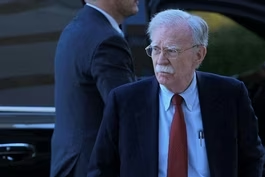
GEOFF BENNETT: For an additional perspective, we turn now to John Bolton, the national security adviser in President Trump's first term.
Ambassador Bolton, it's good to have you on the program.
You have consistently maintained that eliminating the Iranian regime is the only way to end the nuclear threat.
Is this specific military action by the U.S.
and Israel, is it justified, in your view?
JOHN BOLTON, Former U.S.
National Security Adviser: It's totally justified.
Whether it's carried out in a successful way on many different aspects is open to question.
But, to me, the case to eliminate this, not only proliferation-minded barbaric regime, but to eliminate its international terrorist threat, is ample justification for doing what the president has announced.
I don't think you need to make an argument that the threat is imminent.
The threat is bad enough as it is.
Judgments of imminence can be wrong.
I think we're perfectly entitled to do it.
I think it is a war of choice, as most wars are.
And I think it's something that, if it were explained to the American people, they would support.
That hasn't happened yet, and that's one of the things that troubles me.
But the objective of overthrowing the regime is critical, because the regime has consistently shown it will not abandon its pursuit of nuclear weapons and it will not abandon its use of terrorism and its support of terrorist proxies.
If anybody wants peace and stability in the Middle East, this regime has to go.
GEOFF BENNETT: On this being a war of choice, as you said, you heard Senator Warner say that the U.S.
is following Netanyahu's timing on this, which is what Secretary Rubio suggested yesterday before seeking to clarify it today.
Is the U.S.
driving this strategy, or is the U.S.
being drawn into Israel's longstanding campaign against Tehran?
JOHN BOLTON: Look, even I don't think Donald Trump got suckered by Bibi Netanyahu.
Trump knew full well in his first term how Netanyahu felt about the need to overthrow the regime.
I certainly did my best to try and convince him.
This argument has been out there for a long time.
I'm sorry it took this long finally for somebody to take action.
I think the world would have been a lot safer place if we had done it 20 years ago.
But the idea that somehow we were tricked into this doesn't give Trump enough credit.
GEOFF BENNETT: Regime change in the Middle East, as you well know, has been messy, to say the least.
It's been prolonged by instability, sectarian violence, civil conflict.
Does it appear that the Trump administration has a plan for what comes next in Iran after the military action?
JOHN BOLTON: No, and I don't think it's possible to have a plan.
I think, from the U.S.
point of view, we want the regime gone, because almost any other conceivable regime is going to be better than this one.
The likely outcome is that, if you can fracture the regime at the top, turn Revolutionary Guard general against Revolutionary Guard general against ayatollah, the opposition and elements of the regular military, not the Revolutionary Guard, the regular military, can be brought over.
And you could end up with, in the interim, some kind of military government that would then allow a consultative process for the Iranian people to decide what comes next.
If you say the prerequisite to regime change is knowing that you have got a 500-page plan for what comes next, then you're basically saying you don't believe in regime change.
When we changed our regime, when the founding fathers signed the Declaration of Independence, they didn't have a post-monarchy plan either, and somehow we muddled through them.
GEOFF BENNETT: Can airpower alone accomplish regime change without a costly ground commitment?
JOHN BOLTON: Well, the purpose of the airpower, if it's applied correctly, is to destroy the instruments of state power, particularly the Revolutionary Guard, the Quds Force, and the Basij militia,the instruments of state power that threaten the United States and its friends and allies in the region, Israel and the Gulf Arab states, and that also oppress the people of Iran.
By destroying these instruments of state power, you weaken the ability of the regime as it collapses to retaliate and inflict injuries abroad, and you weaken its ability to repress dissent among its own people.
This also says to leaders of the regime their days are numbered, as one facility after another is destroyed, and says to those people who are potentially able to come over to the side of the opposition that maybe they'd rather not go down with the ship in this case.
And it also tells the opposition that, belatedly, at least, help is on its way.
GEOFF BENNETT: Given what you just said, then, how do you assess Iran's response, the way it has responded with strikes and coordinated missile attacks against multiple Gulf states?
JOHN BOLTON: I think they're making a series of terrible mistakes.
They have a finite number of missiles and drones.
Presumably, we and the Israelis are systematically trying to destroy them.
If I were in their shoes, I would have focused all of my retaliatory attacks on American military bases in the Gulf and Israel.
I wouldn't have spent a single missile or drone attacking civilian targets in the Gulf Coordination Council members across the Gulf.
They have now turned those Arab states from governments that hoped the regime would go, but didn't want to be involved, into governments that now have to be involved.
I think it's just signing -- adding additional signatures to their death warrant.
GEOFF BENNETT: Lastly, should the U.S.
have anticipated better the need for a large-scale evacuation of Americans in the region?
I mean, was there a breakdown in contingency planning?
JOHN BOLTON: Well, I don't think we know enough from the outside to answer that question.
I think the bigger question is why there was a lack of preparation over a period of time, not to talk about the specifics of the operation, but to make the case for regime change.
And I think the answer to that is, within the Trump administration, the isolationists, led by J.D.
Vance, were doing everything they could to avoid this.
And that has, in effect, substantially impaired the president's ability to make his case politically.
So these are hard times for the MAGA isolationists.
And all I can say is, too bad for them.
GEOFF BENNETT: Former Ambassador John Bolton, thank you for your insights, sir.
We appreciate it.
JOHN BOLTON: Thank you.
GEOFF BENNETT: We begin the day's other headlines on Capitol Hill, where Democratic and some Republican senators pressed Homeland Security Secretary Kristi Noem over what they described as overly aggressive immigration enforcement.
Noem's testimony before the Judiciary Committee comes as Congress remains deadlocked over DHS funding, raising concerns about national security at a moment of escalating conflict in the Middle East.
Lisa Desjardins has more.
LISA DESJARDINS: Secretary Noem today fielding her first direct questions from Congress since the immigration crackdown that was deadly in Minneapolis and elsewhere.
(SHOUTING) LISA DESJARDINS: Within seconds, interrupted by chance of "Abolish ICE."
PROTESTER: Abolish ICE!
LISA DESJARDINS: The killings of U.S.
citizens Renee Good and Alex Pretti by federal officers earlier this year led to widespread demands of accountability.
Noem defended Homeland Security's operations.
KRISTI NOEM, U.S.
Homeland Security Secretary: It's important that we distinguish between disagreements over policy and the department's operational responsibility to enforce existing law that has been passed by Congress.
LISA DESJARDINS: Minnesota Democrat Amy Klobuchar, a candidate for governor, questioned the tactics in her state.
SEN.
AMY KLOBUCHAR (D-MN): Do you agree that it is unacceptable for your agents to ram into someone's door and drag someone out in their underwear in below-zero temperatures when they have the wrong guy?
KRISTI NOEM: Our officers conduct targeted operations and utilize the law processes that are given to them and the tools.
SEN.
AMY KLOBUCHAR: You will not answer that you think that's wrong?
KRISTI NOEM: They needed to identify that individual, and that individual... SEN.
AMY KLOBUCHAR: They couldn't identify him by looking at his identification?
LISA DESJARDINS: And two Republicans didn't hold back.
SEN.
THOM TILLIS (R-NC): We're beginning to get the American people to think that deporting people is wrong.
It's the exact opposite.
The way you're going about deporting them is wrong.
LISA DESJARDINS: In a tirade, Thom Tillis of North Carolina called on Noem to resign.
John Kennedy of Louisiana pressed her on spending $220 million on TV ads that feature the secretary front and center.
KRISTI NOEM: We went through the legal processes.
SEN.
JOHN KENNEDY (R-LA): Did the president know you were going to do this?
KRISTI NOEM: Yes.
SEN.
JOHN KENNEDY: He did?
KRISTI NOEM: I think would be helpful to know how effective that communications has been, that overwhelmingly... SEN.
JOHN KENNEDY: Well, they were effective in your name recognition.
LISA DESJARDINS: But other Republicans like South Carolina's Lindsey Graham laid the blame on Democrats.
SEN.
LINDSEY GRAHAM (R-SC): I'd like to make sure, if there was a bad shooting, it's documented as such and people pay a price.
But I will not apologize to anybody in this room to try to clean up the mess that Biden started and you empowered.
LISA DESJARDINS: Directly behind Noem, so-called Angel Families, some of their loved ones killed by undocumented immigrants, others from fentanyl and other drugs smuggled in illegally.
SEN.
RICHARD BLUMENTHAL (D-CT): Leo, Javier, and Marimar, would you please stand?
LISA DESJARDINS: Connecticut Democrat Richard Blumenthal introduced American citizens detained by DHS agents.
One woman was shot five times on her way to church.
Noem said she wasn't familiar with those cases, but throughout she repeated that her officers follow the law and have dramatically cut down illegal border crossings.
KRISTI NOEM: You don't talk about the good work that they do to protect people from being victimized, right, people that are in this country that want to conduct violent crimes against them or take advantage of them.
The laws need to apply to everyone.
LISA DESJARDINS: Democrats argued she's breaking laws, not following them.
SEN.
CORY BOOKER (D-NJ): Either you are utterly incompetent or you are violating laws with impunity.
LISA DESJARDINS: Most Republicans defended her.
SEN.
TED CRUZ (R-TX): Thirty-one million Texans say thank you.
LISA DESJARDINS: A divisive hearing and secretary who faces more questions tomorrow from House members.
For the "PBS News Hour," I'm Lisa Desjardins.
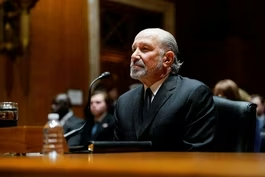
GEOFF BENNETT: Meantime, another member of Trump's Cabinet has agreed to face questions on a separate issue.
Commerce Secretary Howard Lutnick will voluntarily testify in the House Oversight Committee's investigation into the late sex offender Jeffrey Epstein.
That's according to the committee's chairman, though no date has been set.
Lutnick told Axios -- quote -- "I look forward to appearing before the committee.
I have done nothing wrong.
And I want to set the record straight."
He used to be Epstein's neighbor in Manhattan and has admitted to visiting Epstein's private island back in 2012.
Lutnick has not been accused of any wrongdoing.
The 2026 midterm elections officially kicked off today with voters heading to the polls in Texas, North Carolina and Arkansas.
In Texas, the most expensive Senate primary in state history has Republican incumbent John Cornyn fighting for his political survival in a three-way race that could force a run-off, while the Democratic race pits State Rep.
James Talarico against Congresswoman Jasmine Crockett.
In North Carolina, voters are selecting nominees to run to replace retiring Republican Senator Thom Tillis in November.
And Republican voters in reliably red Arkansas are likely to renominate Senator Tom Cotton and Governor Sarah Huckabee Sanders as the party's candidates.
In Georgia, the father of an alleged school shooter was himself found guilty of second-degree murder today.
MAN: Count two, cruelty to children in a second degree, we, the jury, find the defendant guilty.
GEOFF BENNETT: It took a jury less than two hours to find Colin Gray guilty of all 29 charges against him.
Gray gave his then 14-year-old son the gun he allegedly used to kill two students and two teachers at Apalachee High School in 2024.
Prosecutors say he did so despite sufficient warning that his son would harm other people.
Gray joins a growing number of parents who have been prosecuted for the actions of their children.
He will be sentenced at a later date and faces a maximum of 180 years in prison.
Officials in Pakistan say Afghan forces attacked its military positions along the border today, though there are conflicting reports on casualties.
Pakistani authorities say at least 67 Afghan troops were killed, with local hospitals treating residents who were caught up in the fighting.
Afghanistan's Defense Ministry rejected those figures, instead saying that Afghan troops repelled the attacks and killed four Pakistani soldiers.
The conflicting reports come on a fifth day of violence, which started with the Taliban-led government in Afghanistan, launching attacks last week as a response to earlier Pakistan airstrikes.
ENAYATULLAH KHOWARAZMI, Afghan Defense Ministry Spokesman (through translator): It must be clearly stated that we did not choose war, but, unfortunately, the Pakistani military regime has repeatedly violated our territory and martyred our civilians.
As a result, no other option remained.
GEOFF BENNETT: Pakistan says it does not target civilians and instead accuses Kabul of providing a safe haven to the militants who target the Pakistani government.
For its part, Afghanistan's government denies those claims.
There has been more fallout from the deal between the Pentagon and artificial intelligence giant OpenAI.
The Wall Street Journal is reporting that CEO Sam Altman defended his decision on an all-staff call to allow defense officials to use the company's A.I.
tools for classified work.
It comes after he announced a revision to the deal to make sure OpenAI's technology would not be used for mass surveillance.
And, last night, he posted on social media that announcing Friday's deal so quickly was, in his words, opportunistic and sloppy.
OpenAI's agreement with the Pentagon came shortly on the heels of a federal ban on rival Anthropic's A.I.
tools.
We have an update now on a story we brought you last night.
The Trump administration is reviving its effort to punish law firms seen as supporting the president's political opponents just a day after signaling it was dropping the fight.
At issue is a series of executive orders signed by President Trump last year that would have hampered the work of four prominent law firms.
Those orders were blocked by federal judges and the Justice Department appealed.
Yesterday, the DOJ said it was dropping those appeals, which was seen as a major retreat for the administration.
Then, today, officials asked an appeals court to withdraw that request, which seemingly puts the legal battle back on track.
California's governor is criticizing the U.S.
Supreme Court's decision to temporarily block a state law banning public schools from outing transgender students to their parents.
A spokesperson for Governor Gavin Newsom said teachers should be focused on teaching, not forced to be gender cops.
The law bans automatic parental notification if students change their gender identity or pronouns.
California officials had argued that it gave students privacy, especially if they feared rejection from their families.
But the Supreme Court sided with Christian groups who say it allowed schools to mislead parents.
On Wall Street today, Iran worries weighed on the markets, though stocks ended well off their lows of the day.
By the close, the Dow Jones industrial average was down around 400 points.
The Nasdaq dropped more than 230 points.
The S&P 500 also ended lower.
And sky gazers around the globe were treated to a total lunar eclipse earlier today, commonly called a blood moon.
It occurs when our planet moves directly between the sun and the moon, giving the lunar surface a crimson-looking glow, as seen in this image taken this morning from Idaho.
Meantime, in Mexico City's predawn sky, spectators gathered to watch as the lunar eclipse reached its final phase, while, across the world in the Philippines, early risers witnessed the partially-eclipsed moon move through the sky.
The next total lunar eclipse is expected to occur on New Year's Eve 2028, so mark your calendars.
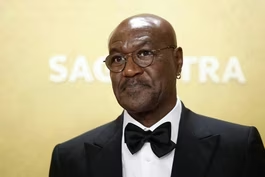
Still to come on the "News Hour": actor Delroy Lindo on his seasoned career and his Oscar-nominated performance in "Sinners."
AMNA NAWAZ: And we will be back shortly.
But, first, take a moment to hear from your local PBS station.
GEOFF BENNETT: It's a chance to offer your support, which helps to keep programs like the "News Hour" on the air.
For those of you staying with us: Few countries in the world are considered more vulnerable to the impact of rising sea levels and climate change than Bangladesh.
AMNA NAWAZ: In partnership with the Pulitzer Center, Fred de Sam Lazaro traveled to Bangladesh to look at efforts to build resilience.
Here's a second look at his report.
FRED DE SAM LAZARO: It is the most crowded space in the most crowded city on Earth by some rankings.
Tens of thousands who live in this slum settlement of Korail are so-called climate refugees, whose previous homes were on land that no longer exists.
JAHANARA, Climate Refugee (through translator): Our house was taken away by the river.
FRED DE SAM LAZARO: Sixty-five-year-old Jahanara - - she uses only one name -- moved here some two decades ago.
Her family's home was lost, like tens of thousands of others over the years, to erosion or, where on land, swallowed by a rising sea.
Jahanara scrapes by, earning $2 to $3 a day cleaning houses and selling scrap.
JAHANARA (through translator): I have lived a very difficult life.
I have worked hard.
I still work hard.
FRED DE SAM LAZARO: With three major rivers and hundreds of tributaries, most swollen by rising seas and melting Himalayan glaciers, no part of this low-lying country, coastal or inland, is spared.
I'm standing on an embankment along the Padma River.
It feels nice and solid, but until about four days ago, it stretched out further for another quarter-mile or so.
All of a sudden, it simply sank into the river, taking with it several homes and a few shops.
And the people here say it all happened in about 15 minutes.
ARIF MADBOR, Erosion Victim (through translator): I was at my father-in-law's house when I got a phone call.
FRED DE SAM LAZARO: Arif Madbor lost his family home.
ARIF MADBOR (through translator): When I arrived, I saw that many houses had gone under the river.
Our house had also been destroyed.
PARVAS HUSSEIN, Former Shop Owner (through translator): Now we are destitute.
FRED DE SAM LAZARO: Parvas Hussein owned a grocery shop here.
PARVAS HUSSEIN (through translator): The first thing we need now is a sustainable embankment, so people like us have a livelihood in the future.
FRED DE SAM LAZARO: For now, sandbags are all that's available to retain what land is left.
Many families will likely join informal communities like this one just up the river on a stretch of public land.
RUSHIYA BEGUM, Climate Refugee (through translator): No one gave us this land.
We were helpless.
So, we found this land and built a house here.
FRED DE SAM LAZARO: Rushiya Begum arrived here last year, escaping erosion that has displaced her three times before, she says, most recently sweeping away her land and most of her livestock.
RUSHIYA BEGUM (through translator): Our lives have been filled with hardship.
We cannot even afford sandals.
ATIQ RAHMAN, Executive Director, Bangladesh Center For Advanced Studies: The communities have learned to accept their realities, because they don't have the luxury of time.
FRED DE SAM LAZARO: Environmental scientist Atiq Rahman agrees with estimates that, by 2050, Bangladesh will lose 17 percent of its territory due to rising sea levels, including 30 percent of its agricultural land.
He says Bangladeshis are slowly finding ways to adapt.
ATIQ RAHMAN: You can do intellectual adaptation.
You can do physical adaptation.
You can do agricultural adaptation.
You can do water-based adaptation, all that.
FRED DE SAM LAZARO: Monsoon floods routinely keep children out of school, says architect Mohammed Rezwan.
His solution was to bring school to the boat.
In 2002, he designed and launched the first flat-bottom boats to serve as primary schools.
Today, the fleet has expanded to more than 100 boats, serving across a swathe of Northwest Bangladesh, not just as schoolrooms, but also as libraries, clinics, playgrounds and training centers.
MOHAMMED REZWAN: We are trying to develop people's skills towards resilience.
It has high windows to let light and air in.
We train on sustainable, effective and climate-friendly farming techniques, focusing more on traditional knowledge of climate adaptations.
FRED DE SAM LAZARO: We visited this training session teaching women organic low-cost methods to protect their crops from pests.
MAHMUDA KHATUN, Agriculture Student (through translator): I get a good result using this trap to protect my eggplant field.
Flooding actually damages our crops, but the vegetables that we grow around our home, we can actually get good production.
FRED DE SAM LAZARO: Garden vegetables provide much-needed nutrition, and Rezwan's nongovernment group has encouraged people to try new ideas, like fish farms and raising ducks on the river.
However, the bedrock of this country's food security is rice.
Even though it naturally thrives in water, it too is susceptible to climate change.
Floods can wipe out a harvest, or a crop may not survive in soil that's become salinized with seawater.
We visited this seed bank run by BRAC, the world's largest nongovernment organization which began in Bangladesh.
Scientists here are developing hardier varieties of rice and other seeds.
FARUK HOSSAIN, Agronomist, BRAC: Flood resistance are available.
Some are drought-tolerant, saline.
FRED DE SAM LAZARO: Many of these farmers can only grow that kind of rice... FARUK HOSSAIN: Correct.
Correct.
FRED DE SAM LAZARO: ... in parts of the country.
FARUK HOSSAIN: That's right.
FRED DE SAM LAZARO: Because the soil has become so soggy with sea water.
FARUK HOSSAIN: Correct.
Correct.
Correct.
Soggy, yes.
ASIF SALEH, Executive Director, BRAC Bangladesh: We have to come up with solutions that are scalable and then figure out where the funding comes from later on.
Meanwhile, those most vulnerable must temper their expectations as they try to adapt.
RUSHIYA BEGUM (through translator): The one good thing is we are living on dry land, for now.
FRED DE SAM LAZARO: Down even to what passes for dry land these days, and how long Rushiya Begum can remain on it.
She'd just been served an eviction notice from the Bangladesh Bridge Authority.
The land is needed for a Chinese engineering company, pushing her once again to the edge of despair.
RUSHIYA BEGUM (through translator): If you don't allow me to stay, then I will have to move.
Or if you want to throw us into the water, you can throw our life into the water.
FRED DE SAM LAZARO: By 2050, it's estimated that climate change will displace another 20 million people in this country.
For the "PBS News Hour," I'm Fred de Sam Lazaro in the village of Alamkar Kandi (ph), Bangladesh.
GEOFF BENNETT: "Sinners," directed by Ryan Coogler, made Oscars history recently when it earned a record 16 Oscar nominations.
One for best supporting actor went to Delroy Lindo, a 73-year-old widely respected veteran now receiving his first nomination.
Senior arts correspondent Jeffrey Brown met Lindo recently in New York for our arts and culture series, Canvas.
JEFFREY BROWN: On a dirt road in Mississippi, three men come upon a chain gang.
One of them, Delta Slim, played by Delroy Lindo, exhorts the prisoners.
(SINGING) MICHAEL B. JORDAN, Actor: Hey, you knew some of them?
DELROY LINDO, Actor: All of 'em.
It's very specific.
1932, a very particular community, Clarksdale, Mississippi, 1932.
But it has, in my estimation, transcended itself and become much more universal.
JEFFREY BROWN: Lindo is part of the extraordinary ensemble cast of "Sinners," part historical drama of race in the Jim Crow South, part horror film complete with vampires, all bold filmmaking by director and writer Ryan Coogler.
In the lead, Michael B. Jordan, playing two roles.
The Smokestack twins, returned to their Mississippi Delta home, determined to build a juke joint, alive with the blues and the musicians who play it, Miles Caton, Sammie Moore, Lindo's Delta Slim.
DELROY LINDO: Blues wasn't forced on us like that religion.
Nah, son, we brought this with us from home.
It's magic, what we do.
It's sacred and big.
JEFFREY BROWN: "Sinners" is such an unusual mix of things.
DELROY LINDO: It is.
JEFFREY BROWN: When you first heard about it or when you first read the script, did you get it?
DELROY LINDO: Yes.
When I first read it and the first -- as we were working on it, for me, it always resonated in terms of it being a story about a community that is infiltrated, a vibrant community, a vibrant self-sustaining community.
What happens when that community is infiltrated?
And from that standpoint, it felt very, very, very contemporary to me.
JEFFREY BROWN: In what sense?
DELROY LINDO: That there are a lot of communities being infiltrated and violated,people who are considered to be less than unworthy, not worthy being picked on and bullied and violated.
JEFFREY BROWN: Lindo himself started in theater.
His Broadway debut came in 1982 in the apartheid era drama "Master Harold and the Boys."
And he received a Tony nomination for his performance in August Wilson's "Joe Turner's Come and Gone" He's appeared in numerous TV series and movies and is perhaps best known for his work with director Spike Lee in four films, "Malcolm X," "Crooklyn," "Clockers," and 2020's "Da 5 Bloods," a commanding presence and emotional depth on display in that driving scene in "Sinners," which ends with Lindo' character describing the lynching of his friend.
DELROY LINDO: Klan got ahold to him, searched his pockets, found all that money, made up a story about him killing some white man for it and raping that white man's wife.
And they lynched him right there in the railroad station.
JEFFREY BROWN: Before dissolving into a wordless, blues-inflected moan.
(SINGING) JEFFREY BROWN: Was that written that way or... DELROY LINDO: No, that happened the last few takes that we worked on.
JEFFREY BROWN: Really?
DELROY LINDO: Yes.
And it came out of -- it was very organic.
And that moment came out of everything that had preceded it.
JEFFREY BROWN: So it's in real time?
DELROY LINDO: Absolutely.
It comes out as a holler.
It comes out as a moment, an emission of sound, an emission of music, as a result of the fact that there are no words left.
JEFFREY BROWN: There's just pain.
DELROY LINDO: Yes, pain, but it's the navigation of pain.
It is not the moment of a victim.
I'm not victimized.
I'd like to believe I'm expressing this is how I deal with the pain.
MICHAEL B. JORDAN: They ain't paying you $20 a night.
I know that.
DELROY LINDO: You ain't paying no $20 a night.
You paying $20 maybe tonight.
JEFFREY BROWN: Lindo says this first nomination and the outpouring of joy from others who've long thought he deserved more recognition make this a special moment.
His acting road has not always been an easy one.
DELROY LINDO: A sinner like me, I can't ask for more than that.
JEFFREY BROWN: You felt that, right?
DELROY LINDO: Sure.
And there have been ups and downs.
JEFFREY BROWN: What's been the hardest for maintaining a career?
DELROY LINDO: Good question.
The hardest for maintaining a career for me was maintaining the belief in myself and in my ability to continue working, even when the evidence said otherwise, even when there was no job.
(LAUGHTER) DELROY LINDO: Even when there was no job, I had to believe.
JEFFREY BROWN: The world is telling you one thing, but you have to tell yourself something else.
DELROY LINDO: Exactly right.
Certainly, I have been despondent.
Certainly, I have been -- my belief has been rocked, but I have never been completely down and out.
What I would say to any younger actor is, any person, a part of one's strength is in having the ability to get up off the canvas, if one is down on the canvas, to get up and find a way to keep moving forward.
That's what I have done.
JEFFREY BROWN: Delroy Lindo, Delta Slim, goes for his best supporting actor nomination on March 15.
For the "PBS News Hour," I'm Jeffrey Brown in New York.
AMNA NAWAZ: And that is the "News Hour" for tonight.
I'm Amna Nawaz.
GEOFF BENNETT: And I'm Geoff Bennett.
For all of us here at the "News Hour," thanks for spending part of your evening with us.
 New
NewBolton says Iran war critical for stability in Middle East
Video has Closed Captions
Clip: 3/3/2026 | 6m 59s | Bolton says Iran war justified and critical for 'peace and stability' in Middle East (6m 59s)
 New
NewDelroy Lindo on his Oscar-nominated performance in 'Sinners'
Video has Closed Captions
Clip: 3/3/2026 | 6m 44s | Delroy Lindo on the cultural impact of 'Sinners' and his Oscar-nominated performance (6m 44s)
 New
NewIran hits American diplomatic targets in Middle East
Video has Closed Captions
Clip: 3/3/2026 | 6m 4s | As U.S. escalates attacks, Iran hits American diplomatic targets in Middle East (6m 4s)
 New
NewNews Wrap: Lutnick will testify in House Epstein probe
Video has Closed Captions
Clip: 3/3/2026 | 6m 14s | News Wrap: Lutnick will testify in House investigation into Epstein (6m 14s)
 New
NewNoem defends aggressive immigration enforcement tactics
Video has Closed Captions
Clip: 3/3/2026 | 3m 40s | Noem defends aggressive immigration tactics amid bipartisan criticism (3m 40s)
 New
NewTehran faces 4th day of strikes from U.S.-Israeli forces
Video has Closed Captions
Clip: 3/3/2026 | 3m 36s | Tehran endures 4th day of intense bombardment from U.S.-Israeli forces (3m 36s)
 New
New'This is a war of choice’ by Trump, Sen. Warner says
Video has Closed Captions
Clip: 3/3/2026 | 6m 50s | 'This is a war of choice' by Trump and Netanyahu, Sen. Warner says after Iran briefing (6m 50s)
 New
NewTrump pushes back at conservatives critical of Iran war
Video has Closed Captions
Clip: 3/3/2026 | 5m 15s | Trump pushes back at conservative voices critical of Iran war (5m 15s)
Providing Support for PBS.org
Learn Moreabout PBS online sponsorship
- News and Public Affairs

FRONTLINE is investigative journalism that questions, explains and changes our world.

- News and Public Affairs

Amanpour and Company features conversations with leaders and decision makers.











Out Of The Dark: Teens Talk Mental Health
Support for PBS provided by:
Major corporate funding for the PBS News Hour is provided by BDO, BNSF, Consumer Cellular, American Cruise Lines, and Raymond James. Funding for the PBS NewsHour Weekend is provided by...