
July 16, 2026 - PBS News Hour full episode
7/16/2026 | 57m 46sVideo has Closed Captions
July 16, 2026 - PBS News Hour full episode
July 16, 2026 - PBS News Hour full episode
Problems playing video? | Closed Captioning Feedback
Problems playing video? | Closed Captioning Feedback
Major corporate funding for the PBS News Hour is provided by BDO, BNSF, Consumer Cellular, American Cruise Lines, and Raymond James. Funding for the PBS NewsHour Weekend is provided by...
July 16, 2026 - PBS News Hour full episode
7/16/2026 | 57m 46sVideo has Closed Captions
July 16, 2026 - PBS News Hour full episode
Problems playing video? | Closed Captioning Feedback
Where to Watch PBS News Hour
PBS News Hour is available to stream on pbs.org and the PBS app.
Providing Support for PBS.org
Learn Moreabout PBS online sponsorshipGEOFF BENNETT: Good evening.
I'm Geoff Bennett.
Amna Nawaz is away.
On the "NewsHour" tonight: President Trump is set to make election conspiracy theories a central focus of a prime-time address tonight.
A fact-check, as he revisits the 2020 election.
Smoke from wildfires in Canada blankets multiple states across the Midwest and mid-Atlantic.
And state and federal lawmakers push for stronger guardrails on kids' use of artificial intelligence.
But some advocates say blanket bans are missing the mark.
MICHELE JAWANDO, CEO, Omidyar Network: The onus of putting kind of restrictions, again, falls on families.
It falls on parents who are just trying to figure it out.
What we really want to ask are companies to design safer products.
(BREAK) GEOFF BENNETT: Welcome to the "News Hour."
President Trump will speak tonight from the White House, where he is expected to make new claims about foreign interference in the 2020 presidential election.
The speech marks an escalation of his yearslong effort to relitigate the election he lost.
His repeated false claims about the 2020 vote have been rejected by courts, election officials, and independent assessments, which found no evidence of widespread fraud.
Our White House correspondent, Liz Landers, joins us now with a preview.
So, Liz, you have been reporting on this since the president announced this speech earlier this week.
What is he expected to say tonight?
LIZ LANDERS: The president is saying that this is going to be really, really big news.
And he went on to say on Tuesday that "It doesn't get bigger, because without free and fair elections, you don't have a country."
Karoline Leavitt also gave a bit of a preview during the press briefing earlier today.
KAROLINE LEAVITT, White House Press Secretary: We should have the safest and most secure elections in the history of the world.
And what the president will be speaking about tonight will show you that perhaps that is not the case.
And we need to make some adjustments moving forward, including the SAVE America Act.
LIZ LANDERS: Geoff, elections in this country are very safe and secure, and voter fraud is incredibly rare.
So, based on what we have heard from the president in the past, it seems that he may repeat falsehoods about the 2020 election, as he has done repeatedly.
Nick Schifrin and I are hearing from sources that the president is expected to claim foreign election interference from China in the 2020 elections.
Sources that we're speaking to say that there are thousands of pages of intelligence documents that the president is going to point to as evidence of this.
And we should also expect the president to mention some of the key swing states that he lost, like Georgia, during this speech later this evening.
GEOFF BENNETT: And the president has remained fixated on this 2020 election loss.
Many of the claims he's expected to repeat tonight have been repeatedly refuted, including by members of his own administration.
Walk us through that history.
LIZ LANDERS: His own administration in 2020, as you just said, put out a number of intelligence assessments after that election looking into whether there was foreign interference and meddling in that.
John Ratcliffe was the director of national intelligence in 2020.
He is now the CIA director.
And there was a DNI report that was released that I think there are two key points here that we should review.
This was given to President Trump in January of 2021.
It says: "There are no indications that any foreign actor attempted to alter any technical aspect of the voting process in the 2020 U.S.
elections, including voter registration, casting ballots, vote tabulation, or reporting results."
This assessment also said this of China -- quote -- "China did not deploy interference efforts and considered, but did not deploy influence efforts intended to change the outcome of the U.S.
presidential election."
On the other hand Geoff, the intelligence community did assess that President Putin of Russia tried to influence the 2020 elections to denigrate President Biden, and Iran tried to influence the elections to denigrate candidate Trump.
So here's what the president's own attorney general, Bill Barr, said when he spoke to the January 6 Committee when he was asked about these non-truths, these conspiracies from the president.
WILLIAM BARR, Former U.S.
Attorney General: I saw absolutely zero basis for the allegations, but they were made in such a sensational way that they obviously were influencing a lot of people, members of the public, that there was this systemic corruption in the system and that their votes didn't count, and that these machines controlled by somebody else were actually determining it, which was complete nonsense.
LIZ LANDERS: And Attorney General Barr was not the only Cabinet official or adviser of the presidents from 2020 who apparently said this to him.
There were a number of Republicans and close advisers to Trump who said to the January 6 Committee a few years ago that they told the president that these were not true conspiracies that he was hearing.
GEOFF BENNETT: I know, as part of your reporting, you have been speaking with election officials around the country.
What are they telling you about this?
LIZ LANDERS: I have spoken with probably a half-dozen election officials in the last few days since this announcement came out, and they're concerned.
They're concerned about what the president is going to say tonight and how it may undermine people's confidence in the upcoming midterm elections.
I spoke with one Republican in a swing state who said to me yesterday that every Republican that they're talking to says that the last thing that they need to be talking about as a party is voting machines in the 2020 election.
This person said: "We as a party need to talk about affordability and other issues that are important to the public."
I spoke with another election official in Arizona who's watching this speech closely, because Arizona has primary races on Tuesday of this week.
And this person said: "I don't know what the president is going to say and whether this will somehow impact our election administration next week."
And then, finally, the secretary of state of Arizona, Adrian Fontes, and I spoke on the phone yesterday.
And he made the point that the president and this administration keep challenging the way that elections are administered, these mail ballot challenges that we have seen, these executive orders about turning over election data.
He says: "This administration keeps losing these challenges in court."
And he thinks that this speech tonight will be another futile attempt to influence an area that the president and the executive branch has no influence over.
GEOFF BENNETT: Liz Landers, thank you, as always, for this terrific reporting.
We appreciate it.
LIZ LANDERS: Of course.
GEOFF BENNETT: Well, you can watch PBS News' livestreaming coverage of President Trump's prime-time address tonight at 9:00 p.m.
Eastern on our Web site with context and real-time fact-checking from our partners at PolitiFact.
That's at PBS.org/NewsHour.
Now, for perspective on what the president is trying to achieve with tonight's speech, the limits of his authority, and the potential consequences for future elections, we turn now to Ty Cobb, an attorney who served as the special counsel during the first Trump administration.
I spoke with him a short time ago.
Ty Cobb, welcome back to the "News Hour."
TY COBB, Former White House Special Counsel: My pleasure.
Nice to be with you, Geoff.
GEOFF BENNETT: Ty, you have described a broader pattern here, President Trump's focus on voting machines, his efforts to change mail-in voting, voter registration requirements, most recently his removal of members of the Election Assistance Commission.
What does tonight's speech add to that picture?
TY COBB: Well, I think tonight's speech is intended to add the predicate that he needs to declare an emergency at or about the time of the elections.
As you know, Steve Bannon and Todd Blanche have suggested that there will be ICE agents at the polls.
I think that that's a virtual certainty.
Whether that will include the National Guard or not, we don't know, but anything to -- anything to intimidate minority voters, particularly immigrant voters, and also I think anything that allows them to try to seize voting machines, as Trump wanted to do in 2020, but Bill Barr explained to him there was just no basis for it.
I think you will I think you will see him doing everything he can to try to prevent the peaceful transfer of power, the election of Democrats, and do whatever he can to remain in power and to keep his cronies in power, so that he can continue doing what he thinks he's allowed to do as president, which is anything he wants.
GEOFF BENNETT: President Trump has said in the past that he believes, if Democrats win control of Congress in the midterms, that he will be impeached.
When you say that you believe he's intent on declaring a national emergency, what guardrails remain if the president does, in fact, use the power of the federal government to shape how the midterm elections are conducted?
TY COBB: I think the only real guardrail is for people to get to the polls, to vote against the level of corruption and insanity and frivolity that we have seen, the type of conduct that has made the world more dangerous, and that has enriched President Trump to the tune of somewhere between $4 billion and $8 billion during the time he's been in office.
We know he made $2.2 billion last year, largely on crypto.
We know that his stock trades were -- he had hundreds of stock trades last year, if not thousands.
I think Obama had zero, Biden had 13, by comparison.
And that many of those stock trades were followed by statements from Trump touting -- touting the products of the companies that he had bought or giving them government contracts.
So what we have seen is so inimical to what it has historically meant to be an American president, where integrity, courage, straightforwardness, and an interest in the lives of the people that are being governed were at the front and center.
We have a president now who's there solely to enrich himself, his family, and his cronies, and to wield power in a way that satisfies his basest instincts.
We need people to come out and vote against that.
That is the -- that is the guardrail.
Internally, unlike the first administration, when you had people like General Kelly, General Mattis, Nikki Haley, Mike Pompeo, people of character who would hold up their hand when Trump wanted to do something reckless or self-dealing, we don't have that now.
I mean, we have the Stephen Millers of the world, the Todd Blanches, whose mantra is, "I love you, sir, I'm your lawyer," who has overseen revenge prosecutions, the hollowing out of 20 percent of the lawyers in the Department of Justice.
Most of the most experienced and talented lawyers who were in leadership positions, they're gone now.
And we have redirected FBI and DOJ resources under Blanche and Patel to immigration cases, to the exclusion of counterterrorism cases, money laundering cases, fraud, and civil rights.
So I think we need people to come out and vote against that.
That's the best guardrail we have, and that's the only remaining guardrail in our democracy.
GEOFF BENNETT: And yet, if there were genuine vulnerabilities in voting machines or attempts by China to interfere, those would be major national security concerns.
How should a president responsibly address those concerns, without using them to undermine confidence in an election that has already been settled?
TY COBB: Well, I think, when you say those concerns, I mean, those concerns are inflated, overrated, and exaggerated.
There is evidence historically that China and Russia had some influence peddlers, that Iran and Venezuela have, that we do -- we do this around the world as well, trying to influence people in the -- in public opinion.
But on the voting machines, that's been looked at.
And, frankly, when FOX tried to support Trump's wild claims about abuse voting machines in 2020, it cost them almost a billion dollars, $787 million that they had to pay out for fraudulently supporting Trump's unfounded claims.
And we're going to see -- we're going to see that again.
You know, Trump's going to make more unfounded claims.
The intelligence that comes into the CIA and the FBI is always graded.
Some of it's good.
Some of it comes from reliable sources.
Some of it comes -- arises under circumstances that have some credibility.
None of the stuff that we're going to hear tonight is that, and particularly the Venezuela stuff.
I mean, he's going to use Maduro, probably fabricate a statement of facts to support a guilty plea for Maduro, which will later be followed by the type of Ghislaine Maxwell treatment, where he gets favorable treatment in exchange for doing what the administration wants.
I think it's - - I think people need to see through this.
And you're not going to see reliable people, people historically who have the respect of the American people, the intellectuals, the historians, the journalists.
You're going to see people of the type of Bill Pulte and John Solomon, who have been conspiracy theorists from the start, who are willing to do whatever Trump asks supporting these claims.
But you're not going to see many credible people do this.
And I think people need to -- when they - - when you talk about serious claims, I think the serious is the -- is the flaw in that statement, because they aren't serious.
This is unserious.
This is Trump acting out his fantasy and trying -- trying desperately to push his minions to help him pretend, as he has rewritten history over January 6, as he has rewritten history about the 2020 election to go along with him.
GEOFF BENNETT: Ty Cobb, thanks again for making time for us this evening.
Good to speak with you.
TY COBB: My pleasure.
GEOFF BENNETT: And we start the day's other headlines in Ukraine, where thousands poured into the streets today to protest President Volodymyr Zelenskyy's decision to fire his popular defense minister.
GEOFF BENNETT: The crowds chanted "Shame" in a rare public challenge of Zelenskyy's leadership.
Mykhailo Fedorov was seen as an innovator of the country's use of drone technology in Ukraine's war effort.
But he often clashed with the more traditional military establishment.
While hosting British Prime Minister Keir Starmer in Kyiv today, Zelenskyy insisted that his decision was necessary.
VOLODYMYR ZELENSKYY, Ukrainian President (through translator): To be to be honest, the president is not supposed to pick sides in this kind of situation during wartime.
I would very much like unity.
I'm simply pointing out that, if the sides cannot resolve the issue, I will have to resolve it myself.
GEOFF BENNETT: Another part of Zelenskyy's government reshuffle, Ukraine's Parliament approved a new prime minister today, the former head of a state energy company.
Sergii Koretskyi is the third person to hold the role since Russia's invasion more than four years ago.
In Gaza, health officials say several Israeli attacks in recent days have killed at least a dozen people.
A series of overnight airstrikes killed three family members in Central Gaza.
That's according to a local hospital.
Israel has not commented on those strikes.
The near daily attacks come despite a cease-fire that took effect last year between Israel and Hamas.
Today, family members held funeral prayers for their loved ones and voiced anger over the ongoing violence.
JIBRIL KHATTAB, Nuseirat, Gaza, Resident (through translator): The entire people of Gaza have not lived a single day or a single moment of the cease-fire.
It's an illusion.
No place in all of Gaza is safe.
All of us are exposed to death, and all of us are exposed to danger because we live under an occupation and under aggression.
GEOFF BENNETT: In a separate strike this week, six police officers and a woman were killed in Gaza.
Israel has said that some of them were Hamas militants, but provided no evidence.
More than 1,100 people in Gaza have been killed since the cease-fire took effect, along with at least five Israeli soldiers.
In Texas, Governor Greg Abbott says at least one person has been killed in severe flooding that's affecting central and southern parts of that state.
MAN: This is just insane.
There's a playground underwater.
GEOFF BENNETT: Surging waters have turned streets into rivers in some areas.
Authorities say more than 70 people have been rescued in recent days.
Governor Abbott has issued disaster declarations for nearly 60 counties across the state and said today he's deploying resources to address the continued flooding.
GOV.
GREG ABBOTT (R-TX): I just want to make sure that all Texans know that we have more than 1,300 Texas personnel, the National Guard, Texas Department of Public Safety.
We have all resources, boats, helicopters available to make sure we will be doing everything possible to save human life.
GEOFF BENNETT: The National Weather Service is warning of what it calls a deadly flood wave along the Guadalupe River in Texas Hill Country that runs along Camp Mystic, where flooding last year led to the deaths of more than two dozen people, most of them young campers.
A White House teleprompter operator has been placed on unpaid leave as a federal regulator investigates possible insider trading in prediction markets.
Multiple media outlets have identified the staffer as Gabriel Perez, saying he allegedly used his access to speeches like the State of the Union address to make nearly $100,000 on Kalshi.
The platform noticed the unusual betting activity and referred the trades to the Commodity Futures Trading Commission.
White House Press Secretary Karoline Leavitt today called the allegations deeply unfortunate and a disgrace.
On Capitol Hill, acting Attorney General Todd Blanche agreed to meet with survivors of Jeffrey Epstein's abuse late this afternoon after Republican Senator Thom Tillis said he'd only vote to advance his nomination for A.G.
if such a meeting took place.
Blanche needs support from all Republicans on the Senate Judiciary Committee for his nomination to move forward, assuming every Democrat is a no-vote.
Tillis laid out his condition on the second day of Blanche's confirmation hearing, where Epstein survivors and their families stood up to challenge the DOJ's handling of the Epstein files.
DANI BENSKY, Jeffrey Epstein Survivor: We may look like grown adults when you see us now, but we were children., young girls at the time of our abuse.
These are the photos of when our innocence, dreams, and lives were stolen.
GEOFF BENNETT: Epstein survivor Dani Bensky criticized the DOJ and Blanche himself for releasing sensitive information about the survivors.
She implored senators to -- quote -- "think about the girls in these photos" when casting their votes."
Blanche has defended the DOJ's handling of the Epstein case.
The FDA has approved a first-of-its-kind cholesterol pill from drugmaker Merck.
It's called Lipfendra.
And unlike statins, it works by targeting a specific protein that limits the body's ability to clear so-called bad cholesterol.
According to the American Heart Association, about one in four American adults have high levels of such cholesterol, which can increase the risk of heart disease and strokes.
Merck says the pill is set to cost about $300 per month and will be available in the coming weeks.
Well, a drop in tech stocks weighed on Wall Street today.
By the close, the Dow Jones industrial average was down about 100 points.
The Nasdaq dropped nearly 400 points.
The S&P 500 also closed in negative territory.
Still to come on the "News Hour": how an escalation in the war with Iran is putting global shipping at risk; a sharp divide emerges in Congress over billions in aid for Israel; and experimental artist Suzanne Jackson walks us through a new exhibit chronicling decades of her work.
Between now and Saturday, more than 115 million people may be exposed to dangerous smoke and unhealthy air quality levels.
That's because wildfire smoke is spreading and triggering health advisories in at least 17 states from the Midwest to the mid-Atlantic.
Thousands have evacuated northern Minnesota.
In other states, it's led to flight delays, the closure of pools and beaches, and the cancellation of many other outdoor activities.
Stephanie Sy has our report.
STEPHANIE SY: People in Duluth, Minnesota, woke up to some of the world's worst air quality this morning.
Same for the residents of Detroit and Chicago.
CAITLIN SMITH, Minnesota Resident: I felt pretty sick just from... STEPHANIE SY: In Minneapolis, Caitlin Smith was struggling just to breathe.
CAITLIN SMITH: This is just crazy.
I have never experienced something like this in my life before.
I was just exposed to the smoke last night for like five minutes on my bike ride home from work, and I felt really sick.
STEPHANIE SY: It's becoming an all-too-familiar summer site in North America, orange-tinted, smoke-filled skies, like the one over Toronto's famous CN Tower.
PAULA ORESKOVICH, Toronto Resident: As soon as I woke up in the morning, I went outside on my terrace, and you could definitely smell the smoke in the air, and it's very hazy out.
STEPHANIE SY: It's the result of hundreds of wildfires burning in Canada and the Northern U.S.
A train crew near Armstrong, Ontario, capturing the intensity of the flames.
MAN: Oh, yes, look over there.
STEPHANIE SY: Mike Flannigan is a professor of wildland fire at Thompson Rivers University in British Columbia.
MIKE FLANNIGAN, Thompson Rivers University: Most of the fires were started by lightning.
There were some human-caused fires, but the majority are lightning-caused.
STEPHANIE SY: In Northern Minnesota, the fires and smoke have forced the evacuation of the Boundary Waters Canoe Area.
Adding to the fire danger is the oppressive heat enveloping a large section of the country.
MIKE FLANNIGAN: It has been hot, dry, and windy in Minnesota and Northwestern Ontario.
Temperatures exceeded 100 degrees Fahrenheit in Ontario and Minnesota.
It was windy.
You get lightning strike.
Fire starts.
It grows rapidly.
Those temperatures are record-breaking, if not record-smashing, for many parts of Ontario and Minnesota.
And it's part of that heat dome that affected much of Western and Central United States in the last few days.
STEPHANIE SY: A weather system in Canada is steering smoke into the U.S., across the Great Lakes and into the Northeast and mid-Atlantic region.
The cluster of darker dots show where fine smoke particles in the air were measured at dangerous levels today.
MIKE FLANNIGAN: What is typically happening with a high-pressure system -- and these heat zones are high-pressure systems -- as the smoke gets injected high into the atmosphere, the winds carry it, but this ridge of air sinks, warms and dry.
And, as it sinks, it takes the smoke with it.
SEAN SCOVILLE, Minnesota Resident: Pretty Armageddon-like out here.
It is that I think I'm more affected by the way it looks than the way it smells.
STEPHANIE SY: That smoke is more than unsightly.
It's unhealthy.
LUKE MONTROSE, Colorado State University: From a health standpoint, there is no such thing as good smoke.
STEPHANIE SY: Luke Montrose is an environmental toxicologist at Colorado State University.
LUKE MONTROSE: We know it gets into the systemic circulation and likely has impacts on other organs.
And we're starting to see some instances where researchers are seeing effects on brain health, mental health and even the reproductive system.
STEPHANIE SY: And Montrose says, when the air is as bad as it is in the Upper Midwest, there's no sure way to escape it.
LUKE MONTROSE: This is catastrophic smoke.
There are very few spaces that you can go to get away from that kind of smoke.
It is going to infiltrate those spaces.
Even people who have great immune systems and are really healthy will start to have respiratory effects from these levels of smoke, particularly if it lasts an entire day.
STEPHANIE SY: Experts say children, the elderly, and people with chronic illnesses are the most vulnerable.
Symptoms may include sore throats, excessive phlegm, coughing, headaches, and brain fog.
Staying indoors, turning on air conditioners and air filters, and wearing N95 masks can help mitigate the risks.
Forecasters are predicting that the smoke conditions will likely ease by Saturday, but with fire weather getting more intense, this won't be the last of such events.
MIKE FLANNIGAN: In Canada and the United States, we're getting warmer because of human-caused climate change.
And the increases in area burn, fire severity are largely, not solely, due to human-caused climate change.
I can't be any clearer than that.
STEPHANIE SY: As for the fires currently burning, experts say they may continue through autumn and maybe even until the first snowfall.
For the "PBS News Hour," I'm Stephanie Sy.
GEOFF BENNETT: Today, the White House said American and Iranian negotiators continue to speak, even as both sides draw a hard line in public.
The U.S.
military is launching strikes on Iran again tonight, while President Trump has suggested he will soon escalate even further.
For its part, Iran today said control of the Strait of Hormuz is a red line.
Nick Schifrin speaks now to the head of the U.N.
's Maritime Organization about the U.S.-Iran struggle for the strait.
NICK SCHIFRIN: Today, the waterway that is supposed to supply one-fifth of the world's energy is almost entirely shut.
And, today, Iran released video of what it called attacks on U.S.
allies and vowed to never give up control of the Strait of Hormuz.
EBRAHIM ZOLFAGHARI, Iranian Military Spokesperson (through translator): Under no circumstances and in no way will we allow the United States as a foreign and extraregional country to interfere in the Strait of Hormuz.
This is Iran's inviolable red line.
ARSENIO DOMINGUEZ, Secretary-General, International Maritime Organization: The longer and the more that shipping gets used and weaponized, the more that everybody around the world is going to be affected.
NICK SCHIFRIN: Arsenio Dominguez is the secretary-general of the International Maritime Organization, the U.N.
's body in charge of the safety and security of international shipping.
We saw shipping data today that indicated that the number of ships leaving the Strait of Hormuz was in the single digits.
That's a reduction even from the last few days.
Can you confirm that?
And why?
ARSENIO DOMINGUEZ: It is correct.
And, of course, that also responds to the call that I have been making for ship owners and ship operators not to put at risk the lives of innocent seafarers and to try to transit across the Strait of Hormuz, particularly because we have seen an escalation in the conflict between the two parties in the last few days.
And we're going back to where we were before at the beginning of the conflict.
NICK SCHIFRIN: From your perspective, how important is it that full -scale war not resume?
ARSENIO DOMINGUEZ: It's very important.
The impact on the global economy, the shortages of fuel, LNG, as well as fertilizers for food security, these are the things that we're seeing where the costs are going up and the shortages are happening.
So, for the longer this conflict goes on, the more difficult that it will be for shipping to supply that over 80 percent of global goods around the world, and, of course, for the innocent seafarers to be able to go back to the normal lives.
NICK SCHIFRIN: U.S.
strikes are designed to prevent Iran from attacking ships.
KAROLINE LEAVITT, White House Press Secretary: The reason for the recent strikes over the course of the last several days is because Iran violated the memorandum of understanding that we struck with them.
Specifically, in the memorandum of understanding that they signed, they were not to fire on commercial vessels moving through the Strait of Hormuz.
NICK SCHIFRIN: But Iran keeps striking unless ships sail on an Iranian-approved route.
There have been various attempts by the IMO and Oman, as well as by the U.S.
military, to try and create a passageway that would hug the Omani coast, rather than the Iranian coast, so that ships could transverse safely.
Why hasn't that worked?
ARSENIO DOMINGUEZ: Right now, the main reason is the conflict.
Until we have guarantees that no vessel from any country will be affected or attacked, we cannot resume transit in the Strait of Hormuz right now.
This is why the negotiations are so important.
NICK SCHIFRIN: And, today, there is a new risk to global shipping.
In Yemen, the Iran-backed Houthis, who've previously seized and attacked ships, are now threatening to try and close the Bab al-Mandab, the gateway to the Red Sea, 1,300 miles to the southwest of the Strait of Hormuz.
If you had a combined problem of the Strait of Hormuz being largely closed and the Bab al-Mandab not being safe to passage, what's the impact on the world?
What's the impact on international shipping?
ARSENIO DOMINGUEZ: First of all, it's going to be a higher cost, and that's a reality.
So we will see an escalation not only of the cost, on the prices, but a detrimental effect on the seafarers, which will make it even more difficult for us to attract seafarers to the sector to be able to operate the ships.
So this is going to have a rolling effect, where the negative impact we will be feeling more and more, and for a long time.
NICK SCHIFRIN: Last night, Iran released an American detainee, Dena Karari, what President Trump called a gesture of goodwill.
But there is otherwise signs of bad will, and most U.S.
and regional officials predict the war will escalate.
For the "PBS News Hour," I'm Nick Schifrin.
GEOFF BENNETT: Israel's war in Gaza and its joint military operation with the U.S.
against Iran are fueling deep divisions on Capitol Hill, especially among Democrats.
Last night, more than half of House Democrats voted to end U.S.
military funding for Israel.
And a separate provision aimed at strengthening U.S.-Israel cooperation, part of the must-pass annual National Defense Authorization Act, or NDAA, is also exposing sharp differences.
Lisa Desjardins has been on Capitol Hill for much of the day and joins us now.
Lisa, it's great to see you.
So let's start with aid, U.S.
aid to Israel.
What happened this week?
LISA DESJARDINS: For the first time, at least in modern memory, a major political party has seen the majority of its party vote to cut military aid, all of it, to Israel.
This happened yesterday in a vote in the House; 103 Democrats voted to strip all of the military funding to Israel -- that's about $3.3 billion -- out of the bill.
Now, most every Republican voted to keep the funding, so it did end up staying in that bill.
But there's no question this is exposing, as Republicans intended it to expose, a boiling divide in the Democratic Party.
You can also look at the Democratic leaders of the House.
There are the three right there.
Hakeem Jeffries, the leader of the Democratic side, and then the head of the Democratic Caucus itself, Pete Aguilar, they voted against cutting this funding.
But there in the middle, the number two Democrat in the House, voted yes.
That is a very rare break, as you know, from anyone in Democratic leadership.
Again, it's a profound debate.
Some Democrats that I spoke with, like Emanuel Cleaver of Missouri, said, listen, they may not like everything that Netanyahu is doing, but they will not end their support for Israeli aid.
REP.
EMANUEL CLEAVER (D-MO): What Hamas did was one of the worst things I have ever seen or read about during my lifetime.
And I think that we have to make sure that, when Israel is attacked, that they can respond.
LISA DESJARDINS: However, other Democrats are seeing what we saw in recent elections, recent primaries, where we're seeing the base increasingly vote on Israel and increasingly vote in opposition to any more support for Israel, especially funding.
So I spoke with Pramila Jayapal.
She is a progressive.
And I also spoke to the Republican who sponsored this move, Thomas Massie, about what they saw here.
REP.
PRAMILA JAYAPAL (D-WA): This is U.S.
taxpayer dollars.
And we have not upheld the Israeli government to any of our domestic laws or international laws in terms of requirements, completely unaccountable money.
And it has to stop.
REP.
THOMAS MASSIE (R-KY): I think it shows that public opinion is shifting.
I think it shows that it's being reflected in at least one party here in Washington, D.C.
And I think it shows that AIPAC's influence on Washington, D.C., has diminished severely.
LISA DESJARDINS: Now, other Republicans say it benefits them, ultimately.
They think this is still a national security issue that they can win on.
AIPAC itself, as you well -- as know, is one of the most influential groups or has been in Washington.
And I think their future is at stake here.
They know it.
They sent out a statement yesterday after that vote, saying it was just a messaging vote.
However, they said it was dangerous and encouraged enemies of America and Israel.
GEOFF BENNETT: There's also attention on Israel in a different piece of legislation, the defense bill, the NDAA, in particular, this section that would integrate U.S.
and Israel defense technology.
What more should we know?
LISA DESJARDINS: This is why I love "News Hour."
We can get into difficult issues like this.
My colleague Bridget Craig has been looking into this.
And, together, we wanted to raise this section of the NDAA.
This is the House-passed version.
Section 219, it is called, the U.S.-Israel Defense Technology Cooperation Initiative.
This creates essentially, Geoff, a new framework to organize how the U.S.
and Israel work together on some of the most sensitive and critical technology that they share.
Critics of this especially point to one series of phrases, that it would direct data fusion and network integration between Israel and the U.S.
I spoke with Josh Paul.
He's a former State Department official who left the State Department after he -- over protests when the U.S.
sent aid to Israel for Gaza.
He says that this exact statute, this would stipulate -- give Israel too much power in the weapons chain and also in determining policy.
JOSH PAUL, Former State Department Official: That would essentially give Israel the leverage that we currently have to be able to drive U.S.
policy and to shape U.S.
defense approaches.
At the same time, it also vastly expands the range of technologies and emerging technologies, some of the most sensitive capabilities that we have, for cooperation with Israel, including A.I., quantum, biotech, in a way that would, first of all, create a new level of cooperation, but with a partner that has a track record of not protecting U.S.
intellectual property.
LISA DESJARDINS: Others say that's a vast overreaction, this is streamlined, this is accountability.
I spoke with Jonathan Ruhe at the Jewish Institute for National Security of America, and he says this actually could benefit the U.S.
JONATHAN RUHE, Jewish Institute for National Security of America: So it's in the U.S.
interest in terms of how it helps us deal with threats to our military, to our homeland defense, because Israel ends up being a laboratory, much like we're seeing also in Ukraine right now, where they -- Israel is forced almost to develop cutting-edge technologies.
So Israel has a much faster turnaround, not only to produce cutting edge technologies for defense, but also to test them on the battlefield.
LISA DESJARDINS: This is a small part of a big bill, but it was a very high priority, remains a priority for AIPAC.
GEOFF BENNETT: And the NDAA, the defense bill, it sets policy for the military.
It sets its budget.
That's why it's described as a must-pass bill, and yet it's in limbo.
LISA DESJARDINS: Right.
It's usually a bipartisan bill.
As you know, we're not in bipartisan times, by and large.
And there are two issues.
One is the Senate.
The other is the House.
In the Senate, it is being blocked generally by Democrats, who have problems with Iran funding and that defense policy there.
In the House, the House itself has problems passing a number of bills.
There are several issues with the House of the NDAA, but I am told they are going to attempt to pass this bill next week.
Why are we paying attention to it?
This is nothing less than our military policy across the board.
And in the Trump administration especially, that is America's footprint in the world, and it is also how we use our resources.
Republicans in this bill would spend more than we have ever seen before on the military.
So it's very important to watch it.
GEOFF BENNETT: Absolutely.
Lisa Desjardins, tracking that and so many other things for us, we appreciate it.
LISA DESJARDINS: You're welcome.
GEOFF BENNETT: Now to our series on the future of A.I., one of the biggest concerns, how children and teens use it daily.
Companies are taking some steps.
Meta, for example, announced its A.I.
tools will now notify parents if its A.I.
systems believe a teen may be considering suicide or self-harm.
But many say the companies are not doing enough, can't be trusted, and argue more regulation is needed.
The tech philanthropy the Omidyar Network is out with a new approach of its own.
Michele Jawando is the CEO.
And I spoke with her yesterday.
Michele Jawando, welcome to the "News Hour."
MICHELE JAWANDO, CEO, Omidyar Network: Thanks so much for having me.
GEOFF BENNETT: So much of the debate around kids and A.I.
has focused on whether kids should be able to access it entirely and at what age.
I know you say that's the wrong question.
Why?
MICHELE JAWANDO: Yes, I think -- listen, I think access and age verification are a part of the conversation, but we shouldn't end the debate there.
The onus of putting kind of restrictions again falls on families.
It falls on parents who are just trying to figure it out.
What we really want to ask are companies to design safer products.
And, at the end of the day, you have the world's best engineers, who know how to do this, versus parents, who are just trying to figure it out.
And so for us at Omidyar Network, we really focus on design and design standards as a means to a more safe and healthier ecosystem.
GEOFF BENNETT: Nearly nine in 10 kids and teens are already using A.I.
That's according to a national survey.
So, to your point, if banning it isn't really realistic, what protections should exist?
What should those guardrails look like?
MICHELE JAWANDO: So there are a few things.
You have said it so eloquently.
Nine in 10 kids are already using A.I.
Our partners at Common Sense Media share that young people, about a quarter of young people are using A.I.
every day for something.
So the question has to be then on the companies and the platforms themselves to develop safer.
One, how do you restrict manipulative and addictive practices?
That's something that we all can agree on, particularly things like romantic attachment.
The second thing that I would then point to are safety designs.
So how do you have built-in brakes?
How do you make sure that we're not capturing data from young people who are just going on different apps?
And many of the apps that young people use, three and four actually take, share, and sell their data.
So how do you provide greater design features that protect our young people?
GEOFF BENNETT: The House recently passed the KIDS Act, the KIDS Safety Act.
This regulates social media, video games, A.I.
chatbots.
Does that legislation meaningfully address the range of risks as you see them?
MICHELE JAWANDO: The KIDS Act -- and I'm very happy to see Congress start moving in the direction.
Eighty percent of Americans have said we want to see more in this area.
But, again, I think it is the beginning of the conversation.
I don't think it is anywhere near the end.
And there are a few key reasons.
Again, we're putting the onus back on parents.
If most of the work in the KIDS Act is really focused on parental notification, again, I'm a parent.
I'm trying to figure it out.
I'm a parent of four.
What am I doing here?
How am I supposed to lead on this, versus companies who know and have the technical standards and expertise?
So that's the first thing.
The other thing is they're missing something that's called the duty of care in the recent bill that was passed.
And that's a legal term, but essentially what that says is, as a company, if I'm designing a product, I have to design it as safe as I possibly can.
That's all we're saying.
And that's missing from the current bill.
GEOFF BENNETT: So walk us through how a chatbot, an A.I.
chatbot, should behave when it knows it's speaking to a 13-year-old.
MICHELE JAWANDO: Well, first off, I think we believe at Omidyar Network that these are design standards that should apply to everyone.
We actually just launched a partnership with AARP, and we're seeing some of the same nefarious design standards really attacking older Americans, who are also in a loneliness crisis.
So I think design standards that don't focus on manipulating behavior, particularly romantic attachment, or design standards that say here's a brake notification, should be kind of commonsense, basic.
We also want to get away from taking people's data as part of this compromise for using chatbots.
And, finally, having a real conversation with these companies, who know what they can do here and know how to create a safer environment is something that they can and should do, not just the individual consumers who are trying to figure this all out.
GEOFF BENNETT: Your point about data is a good one because there is this concern, how do you actually verify a child's age without creating new privacy risks?
MICHELE JAWANDO: That's right.
So one of the things that we're seeing in -- here in the U.S.
and in countries around the world is the advent of kind of age verification.
But, again, we don't really, particularly here in the U.S., have a privacy kind of safeguard for all of our information.
And so often what's happening is, we're asking companies, private companies, to share my personal I.D.
And yet we don't have any privacy regulation around that.
So we actually believe that there are other ways to address that issue.
One of the things that we have seen are age estimation.
We also, frankly, believe that, if you have privacy baked into your application from the beginning, those are things that you don't necessarily have to have.
GEOFF BENNETT: You know, we're seeing schools restrict smartphones, which is something that most parents support.
Some parents might ask, why should A.I.
be treated any differently?
MICHELE JAWANDO: Yes.
Look, I think the bell to bell -- and we're seeing this in schools across the nation, that they have a ban on smartphones.
And I think that, again, is a part of the conversation.
But access is just one step.
If you and I step back as parents and we really think about this, I can restrict some of the behaviors, but just because I take that away doesn't mean that that application isn't doing something nefarious when they actually pick it back up at 5:00.
And so my question is, are we as a society ready to say we want a better designed product, point blank?
It doesn't matter when you pick it up, whether it's before school or after, but we want a product that's safe for our young people.
And I think we can do that.
GEOFF BENNETT: When it comes to higher education, we saw this striking example at Brown University.
(LAUGHTER) GEOFF BENNETT: And you're laughing because you know where I'm going with this.
MICHELE JAWANDO: I am.
GEOFF BENNETT: So scores on an online midterm, they rose dramatically, and then they dropped when the final was in person, presumably because students had less access to A.I.
Does education itself need to be redesigned to address the reality of artificial intelligence?
MICHELE JAWANDO: There is a fundamental question that I think we have to have in society right now and be prepared to answer.
For the last 20 years, we focused on, how do we develop a knowledge economy?
And then we have created perhaps one of the greatest inventions to help us really think about the vastness of knowledge and information, and it is easily at our fingertips every single day.
That is a great thing.
And yet what we haven't really reckoned with society is what that then means for the process and the systems of how we have thought about what education should do.
In some ways, I understand those young people.
They are looking at a job market that is constantly -- they're constantly hearing A.I.
will replace them, so they have to be at the top of the class.
We're also hearing every day that we're in the a global race around A.I.
So you have all of these pressures, and then we say you have to know how to use A.I.
You have to be A.I.-literate.
And then we have education system that hasn't really caught up and decided how and -- how we use education in the classroom, but yet everyone has it as a part of their curriculum.
So these are real questions about how we learn, what we learn.
I don't think we can ask students just to give rote information or responses.
There is a new way of learning that I think will require all of us to think about critical thinking, about how we grade, about how we talk about these questions.
GEOFF BENNETT: Absolutely.
Michele Jawando, CEO of the Omidyar Network, always a pleasure to speak with you.
MICHELE JAWANDO: Oh, thanks so much, Geoff.
GEOFF BENNETT: An artist who has spent decades experimenting with her materials is getting her first national exposure in her 80s.
Senior arts correspondent Jeffrey Brown traveled to Minneapolis to meet Suzanne Jackson for our arts and culture series, Canvas.
JEFFREY BROWN: There are large paintings that hang in the air, inviting the viewer to walk around.
There's no canvas, no backing at all.
These are paintings literally made of layers of acrylic paint, along with some everyday household items, here, mesh bags, even peanut shells.
They're works that became a signature style for artist Suzanne Jackson.
SUZANNE JACKSON, Artist: The painting becomes the surface and the support.
JEFFREY BROWN: The paint itself is the surface and the... SUZANNE JACKSON: The paint, the paint itself is the surface and support.
JEFFREY BROWN: Yes.
SUZANNE JACKSON: Understanding the strength of paint and how it works with these bags.
Some of these are vegetable produce bags.
JEFFREY BROWN: Yes, why are they in your painting?
SUZANNE JACKSON: Because I don't throw things away.
SUZANNE JACKSON: And I -- well, just try - - and just looking.
I look at something, and I think, OK, structurally, what can I do with the paint?
JEFFREY BROWN: She's been looking and painting a long time and now at 82 is having her first major museum retrospective, an exhibition titled What Is Love without a question mark that started at the San Francisco Museum of Modern Art and is now at the Walker Art Center in Minneapolis.
More than 50 works made since the 1960s, early representational paintings focused on two abiding subjects, Black figures and the natural world, and then a move toward abstraction and more sculptural three-dimensional pieces.
For the artist herself, it's a chance to look back at her love of painting, her obsession with what the medium itself can do.
SUZANNE JACKSON: I look at them with curiosity about, what did I do?
What was I doing each time?
So I look at these and each one -- and even this morning, looking at this painting next to us, I was thinking it has texture that I didn't see before.
It started to dry differently.
So this is an experiment, and all my life, it's been an experiment.
That's what I see in the retrospective.
JEFFREY BROWN: Jackson spent her childhood in San Francisco, where her father was a city bus and cable car driver, and then, in Fairbanks, Alaska.
She was always making art, she says, teaching herself at first, before studying in the 1960s at San Francisco State University, and then in Los Angeles at the Otis Art Institute, where she took a drawing class with influential artist Charles White and met other young Black artists trying to make their way at a time when the institutional art world was still often closed to them.
Jackson turned her own L.A.
studio into Gallery 32, a small self-funded exhibition space that was short-lived from 1968 to 1970, but highly impactful, with shows that included the first Los Angeles survey of Black women artists.
SUZANNE JACKSON: Doing for ourselves and having exhibitions and supporting each other as young artists.
JEFFREY BROWN: Because that was necessary.
SUZANNE JACKSON: Yes, so even to the last bowl of noodles.
That was the way we helped each other out and supported each other.
So that's really what it was about.
It's being young people just determined to do the thing that you love the most.
JEFFREY BROWN: Her own creativity took different forms.
She was a dancer, poet, theater set and costume designer.
She had gallery shows and began teaching, eventually at the Savannah College of Art and Design.
She continues to live and work in Savannah.
But for long periods, she was largely out of public view.
In some ways, she says now, that was healthy, allowing her to play with new ideas.
SUZANNE JACKSON: I was just doing it, just doing something.
No one was paying attention to me, so I could do anything I wanted to do in the studio.
That's really... JEFFREY BROWN: Is that how it felt for... SUZANNE JACKSON: That's really how this happened.
JEFFREY BROWN: Yes?
SUZANNE JACKSON: Because people weren't paying attention.
JEFFREY BROWN: Paintings on rough bogus paper, sculptural paintings pushing away from the wall, works like Woodpecker's Last Blues with feathers and leaves.
Crossing Ebenezer, though, abstract, contains washes of red, the color of blood, and the flow of a river, recalling a Civil War era, mass drowning of emancipated African Americans.
SUZANNE JACKSON: I'm interested in history.
I'm interested in how we got here.
And that's what the abstraction can do.
It's not telling you a story directly.
It's allowing you to think.
I want people to think.
JEFFREY BROWN: It would be several decades before the outside world took full notice.
SUZANNE JACKSON: For a long time, I felt as if I was not.
There were other artists having recognition.
I was still plugging along, still working.
I think that's the thing.
We kept working, no matter whether we received any recognition or not.
JEFFREY BROWN: Did you feel like your -- you would never get that full recognition?
Were there times?
SUZANNE JACKSON: I just didn't expect it.
I might think, oh, it would be nice if I could do this, or I would go to exhibitions, or I'd watch PBS and see people being interviewed and think, oh, my, and all these younger artists are getting recognition, and many in my generation are being ignored.
JEFFREY BROWN: She's ignored no more.
And the exhibition in the Twin Cities, she says, though planned years back, comes at an especially meaningful time following the murder of George Floyd and the more recent ICE surge, arrests and killings of Renee Good and Alex Pretti, traumatizing this community.
SUZANNE JACKSON: For me, then, people coming in, if this is a place where they can come quietly and peacefully, I hope that it gives some kind of rest and peace.
JEFFREY BROWN: As for Jackson herself, she calls the retrospective a privilege, compelling her back to her studio to get to work.
A first major retrospective at 81, now 82, how does that feel?
SUZANNE JACKSON: It's the beginning.
JEFFREY BROWN: It feels like a beginning?
SUZANNE JACKSON: Yes.
JEFFREY BROWN: Suzanne Jackson's exhibition What Is Love moves to Boston's Museum of Fine Arts in September.
For the "PBS News Hour," I'm Jeffrey Brown at the Walker Art Center in Minneapolis.
GEOFF BENNETT: Be sure to join us online and right back here tomorrow for full coverage of President Trump's address on the 2020 election, including analysis from David Brooks and Jonathan Capehart.
And that is the "News Hour" for tonight.
I'm Geoff Bennett.
For all of us here at the "PBS News Hour," thanks for spending part of your evening with us.
 New
NewThe debate over how to protect children as AI use grows
Video has Closed Captions
The debate over how to protect children and teens as AI use grows (8m 39s)
 New
NewHealth risks of wildfire smoke across Midwest, Mid-Atlantic
Video has Closed Captions
The health risks of wildfire smoke across the Midwest and Mid-Atlantic (5m 15s)
 New
NewIran war putting seafarers at risk, UN maritime chief warns
Video has Closed Captions
Iran war driving up costs and putting seafarers at risk, UN maritime chief warns (4m 50s)
 New
NewNews Wrap: Ukrainians protest firing of defense minister
Video has Closed Captions
News Wrap: Ukrainians protest Zelenskyy's firing of defense minister (6m 5s)
 New
NewSuzanne Jackson celebrates decades of art in new exhibition
Video has Closed Captions
Experimental artist Suzanne Jackson celebrates decades of work in new exhibition (6m 35s)
 New
NewTrump setting stage to declare election emergency, Cobb says
Video has Closed Captions
Trump setting stage to declare emergency around midterms, former White House attorney says (8m 2s)
 New
NewVote on U.S. aid to Israel exposes sharp divide in Congress
Video has Closed Captions
Vote on U.S. aid to Israel exposes sharp divide in Congress (6m 48s)
 New
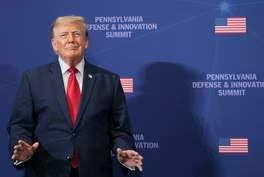
NewWhat to expect from Trump as he revisits 2020 election loss
Video has Closed Captions
What to expect from Trump's address as he revisits 2020 election loss (5m 29s)
Providing Support for PBS.org
Learn Moreabout PBS online sponsorship
- News and Public Affairs

Today's top journalists discuss Washington's current political events and public affairs.

- News and Public Affairs

FRONTLINE is investigative journalism that questions, explains and changes our world.


 New Episode




 New Episode
 New Episode
Support for PBS provided by:
Major corporate funding for the PBS News Hour is provided by BDO, BNSF, Consumer Cellular, American Cruise Lines, and Raymond James. Funding for the PBS NewsHour Weekend is provided by...