
July 18, 2026
6/18/2026 | 55m 29sVideo has Closed Captions
Danny Danon; Daniel Kurtzer; Ann Patchett; Raphael Warnock
Israeli Ambassador to the United Nations Danny Danon discusses Trump's agreement with Iran and what it means for Israel. Former U.S. Ambassador to Israel Daniel Kurtzer also weighs in on how this agreement will affect the Middle East. Ann Patchett discusses her new novel "Whistler." Sen. Raphael Warnock (D-GA) on the upcoming midterms, voting rights and his new book.
Problems playing video? | Closed Captioning Feedback
Problems playing video? | Closed Captioning Feedback
July 18, 2026
6/18/2026 | 55m 29sVideo has Closed Captions
Israeli Ambassador to the United Nations Danny Danon discusses Trump's agreement with Iran and what it means for Israel. Former U.S. Ambassador to Israel Daniel Kurtzer also weighs in on how this agreement will affect the Middle East. Ann Patchett discusses her new novel "Whistler." Sen. Raphael Warnock (D-GA) on the upcoming midterms, voting rights and his new book.
Problems playing video? | Closed Captioning Feedback
Where to Watch Amanpour and Company
Amanpour and Company is available to stream on pbs.org and the PBS app.
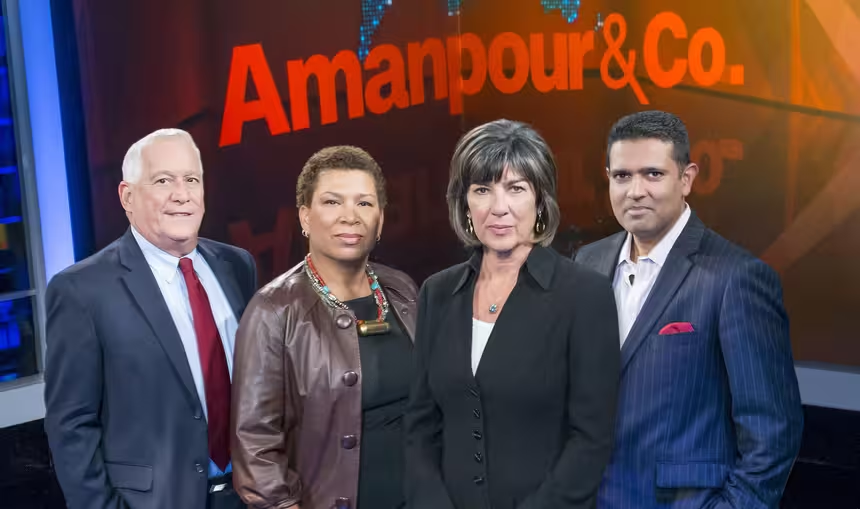
Watch Amanpour and Company on PBS
PBS and WNET, in collaboration with CNN, launched Amanpour and Company in September 2018. The series features wide-ranging, in-depth conversations with global thought leaders and cultural influencers on issues impacting the world each day, from politics, business, technology and arts, to science and sports.Providing Support for PBS.org
Learn Moreabout PBS online sponsorshipHello everyone and welcome to Amanpour & Co.
Here ís what ís coming up.
They say you can do a little softer touch BB.
You don't have to knock down a building everytime somebody walks into it that's from Hezbollah.
Trump takes on Prime Minister Benjamin Netanyahu as tensions between them rise over the Iran agreement.
I get reaction from Danny Denon, Israel's ambassador to the United Nations, and Daniel Kurtzer, the former U.S.
ambassador to Israel.
Then, literary giant Anne Patrick joins me on her latest novel, Whistler, how a chance encounter at the Metropolitan Museum unraveled decades of memory.
Plus... The things that you have taken for granted in an earlier time, in my own lifetime, seem to be slipping away.
The crooked places made straight.
Senator Raphael Warnock speaks with Walter Isaacson about faith, politics, and reimagining a better world.
(upbeat music) - Amanpour & Co.
is made possible by the Committed to Bridging Cultural Differences in Our Communities, and by contributions to your PBS station from viewers like you.
Thank you.
- Welcome to the program, everyone.
I'm Christiane Amanpour in London.
In a late-night tabletop signing at Versailles, the historic site synonymous with sun kings and disastrous peace treaties, President Trump proudly put his pen to the Memorandum of Understanding to end his war on Iran and to begin a 60-day period of negotiations.
His Iranian counterpart signed it in Tehran.
Almost all experts agree the terms of the agreement are enormously favorable to Tehran, but Trump seems determined to present it as a major win for America.
Less so for Israel, though.
There, the MOU has gone down very badly, with allies of Prime Minister Netanyahu expressing outrage.
Not only that, but they are watching in real time as the President of the United States criticizes the PM in public over his continued attacks on Lebanon.
It's appropriate that we release the agreement and we did send a copy to Israel by the way.
They've been a good partner.
Again, I think they could do better with respect to Hezbollah.
I'm not saying they shouldn't protect themselves.
I'm saying when two drones are shot into the desert and drop harmlessly, you don't have to knock down buildings in Beirut.
They could behave better and frankly they could do a better job.
I love them as a partner, they were terrific, but they could do a much better job with Hezbollah.
On that, I don't think they're doing well.
Now, Danny Denan is Israel's ambassador to the United Nations, and he's joining me now from there.
Welcome to the program, Ambassador.
So, how surprised are you to hear this kind of public remonstrations against your prime minister from the President of the United States?
Thank you for having me, Christian.
We have a very strong bond with the United States, with President Trump, his administration.
We fought together.
We won the war together against Iran, and we are grateful for his leadership.
You know, for many years, we heard leaders talking about the threat coming from Tehran, but no one actually took the steps against this regime.
And finally, President Trump was bold enough to take the smart decision, the brave decision, and to team up with Israel to fight the tyranny from Tehran.
And now when he negotiates, we trust that he will do the right thing and will bring a good agreement.
You know, what we are seeing now at the beginning of the negotiations, this MOU is only the start of the negotiations.
And I take him for his word that Iran will not obtain nuclear capabilities.
That is the bottom line, and that is the most important thing.
Well, Ambassador, if you say we won this war, then why is your Prime Minister saying these negotiations, this MOU, is a mistake?
No, I haven't heard the Prime Minister grading the negotiations.
We're going to look at the end result of the negotiations.
We trust President Trump.
He knows how to negotiate.
His commitment that Iran will not have nuclear capability is crucial.
We know that they had that intention.
We degraded their capabilities after a few weeks of very successful attacks.
Now, when the negotiations will be led by the US, I hope and I believe that President Trump will insist on the most important issues and will not allow Iran to play games.
We know that they are the master of deception.
We saw the way they handled the JCPOA, they lied all the way from the beginning.
We hope it will not be the case now.
I'm going to be talking to a veteran American negotiator about the JCPOA.
You know him very well, Ambassador Daniel Kurtz.
But let me ask you this.
President Trump has said Israel mustn't, including mustn't continue its, as you heard him talk about, over-the-top behavior in Lebanon.
And also, Vice President J.D.
Vance has said that Israel has to respect this peace process.
Do you think that is what's going to happen?
And will Israel commit to what's in the MOU, and that is to stop the attacks on Lebanon as well?
Well, first, Christian, we have no beef with Lebanon.
We're actually conducting direct negotiations with the Lebanese government.
And in the last few weeks, we had very strong statements from Beirut.
But with all due respect, why is Iran dictating what will happen in Lebanon?
What is the connection?
They own the government.
So we are conducting our affairs with the U.S., with the Lebanese government.
But if Hezbollah, the proxy of Iran, will continue to attack Israel, we will not sit idly by.
We will defend our citizens.
We will use the might of the IDF against Hezbollah if they will continue to attack our communities.
They decided to start this war against Israel to show support for Iran and Tehran.
We will not be the ones who will actually sit idly by when they send drones and missiles into our communities.
Well, the president, of course, acknowledged that, that every country, including yours, and he's now said Iran, has the right to self-defense.
But he also did say that, you know, Prime Minister Netanyahu should go a little bit of a softer touch.
It's not working, what he's doing with Hezbollah.
And why should he be blowing up buildings if just, and this is, I'm quoting the president, a Hezbollah operative walks into a building?
Why should the whole building be blown up?
Do you think he will change tactics?
We will do whatever is necessary to make sure that Israelis are safe.
After October 7th, we learned that lesson.
We cannot ignore terrorists when they prepare next to our borders.
That's why we pushed Hezbollah away.
And I want to speak about the future.
We want to see a sovereign Lebanon, a free Lebanon.
We signed peace treaties with so many countries.
I believe we can do it with Lebanon, but it will require that it will be one government, one military, without Hezbollah and without Iran running the show in Lebanon.
Look, you said you can't ignore Hezbollah.
Can you ignore the President of the United States?
No, we don't ignore him.
We respect him.
We work with him.
And we saw the cooperation we had together in the last few weeks.
It was amazing.
I saw the way some of the European countries spoke about the President or the effort of the US.
We fought with the US.
Together, we shared the intelligence, we shared capabilities.
We are proud with the Taliban.
We will continue to work together with the US and the Middle East.
Ambassador, you are obviously very, very, very good at diplomacy and very diplomatic.
I'm hearing you spin a beautiful spin on what, from your country and from your prime minister's allies, is being described as a very bad deal and is being described as, in fact, a strategic failure and defeat.
Some are saying that in the United States against President Trump and many in Israel against Prime Minister Netanyahu.
Are you ready to acknowledge that all these years of Benjamin Netanyahu's campaign or mission or whatever you want to call it against Iran, trying to get one president after the other in the United States to attack Iran has actually led to a deal that keeps Iran in place, that has not yet discussed the nuclear operations, that has definitely is not discussing the missiles.
In fact, the president and vice president said Iran has the right to self-defense.
And that is now immediately bringing more money into the Iranian coffers due to waivers by the U.S.
on Iranian oil exports.
I mean, would you say that this whole war has actually left you better off or worse off than before it was started?
Well, first, I think it's premature to give grades to the deal because there is no deal on the table.
There is the MOU for negotiations.
And if there will be a bad deal, we will say it.
You know, the same way we said it when President Obama signed a bad deal.
We stood up and we said it's a bad deal.
We are not part of it.
And we will do whatever is necessary to protect ourselves.
That is not the case.
And I hope it will not be the case in 60 days or whenever the negotiations will conclude.
But I think today we're in a better position after we actually showed Iran the commitment to fight against their intentions.
They realize now that Israel and the U.S.
are not playing games.
We are serious about our commitment.
We are serious about our threats.
And if we mobilize our air forces once, we can do it twice if needed.
So I think today, not only Israel, the entire Middle East, the entire world is in a better position because Iran was pushed back and they don't have the same capabilities they had before this war.
And yet the same are in power and some say even the more hardliners, the more military wing of the Iranian system remains very, very absolutely in power.
Can I just quickly move on to a more local issue, which is also one that really affects the rest of the world, and that is what's happening in Gaza and what's happening in the occupied West Bank.
So more than 1,000 people, according to Palestinian authorities and others, have been killed in Gaza during the ceasefire.
And the Board of Peace envoy says it's unclear how Trump's peace plan will actually proceed to its second phase.
And Israel is taking more land.
I mean, we know that it's now ordered more occupation of Gaza, more like 70% than the previous 60%.
Can you tell me what Israel's plan is for Gaza?
To permanently occupy?
You know, later today I will discuss this issue in the Security Council.
We're going to have a debate about Gaza.
And I will remind my colleagues that if the resolution that was adopted in the Security Council, the Board of Peace recommendation, basically it said that Hamas must disarm.
And then, only after that, we talk about the next stage, about Israel's withdrawal, about the development of Gaza.
But it requires the disarmament of Hamas.
And even Mr.
Mladenov, who is leading the Board of Peace, said it very clearly.
Nothing will happen in Gaza before the disarmament of Hamas.
So we expect that there will be more pressure on Hamas.
And I tell you it very clearly.
If Hamas will not disarm, we will do it ourselves.
We don't want to engage in more conflicts.
You know, we have had a very, very intense three years.
But if Hamas will continue to ignore the Board of Peace decisions and the Security Council resolutions, we will have to engage.
Ambassador Danny Dunant, thank you very much for joining us from New York.
And now we turn to veteran Middle East peace negotiator and the former U.S.
ambassador to Israel, Daniel Kurtzer.
Ambassador, welcome to the program.
Not sure how much you were able to hear of the Israeli ambassador to me, but he was incredibly diplomatic.
And despite what Trump is saying in public, basically against Netanyahu, while also calling him a good partner, despite what the Israelis are saying that this is a bad deal, Danny Dhanon was absolutely clear that we stand shoulder to shoulder, we trust the United States to get the best deal for Israel and for the world in these next 60 days.
How would you assess his comments?
Hi, Christiane.
I admire Ambassador Danone's diplomacy, as you said, but it doesn't reflect what everyone else in Israel is saying.
I just want to start a little bit from the beginning.
You know, when Israel and Iran and the U.S.
first launched their war at the end of February, we tried to get you to come and tell us what you thought might happen.
And you actually back then told our senior producers that, frankly, you were so blindsided, you felt that these two leaders posed such a threat and a danger that you didn't quite know what to respond to back then.
Now, nearly four months later, with this MOU signed, how would you describe what's going on?
Well, Christiane, I backed away from discussing issues back then because I thought it was folly to go to war without very clear strategic goals that were achievable.
Look, after the bombings of last June, a year ago, Iran's nuclear facilities and programs was set back, everyone thought that they had learned the lesson.
Diplomacy was supposed to kick in to see whether or not we could concretize a deal.
And therefore, it was an absolute surprise that the president agreed with Prime Minister Netanyahu to go back at Iran in such a massive way.
If you look back at the goals that have been shifting on and off during this war against what we now see in the MOU, the war was not only a folly to start, but it proves to be a folly in its conclusion.
The United States has basically achieved nothing.
And we are, in fact, worse off than we were before because of Iran's basic control over the Strait of Hormuz.
Ambassador, reporting by CNN White House correspondents suggested that this MOU was really, really designed to satisfy President Trump and, I guess, people around him who just wanted to get this over.
And they just wanted to end this.
So, that's one thing.
You have said that it is essentially a memorandum of understanding of capitulation.
Do you stand by that?
Oh, 100 percent.
Unless there's some magic that's going to happen in the next 60 days when they start negotiating details, at least eight of these elements in the 14-point MOU are so favorable to Iran that Iran is now quite satisfied with its outcome, meaning that it had prevailed.
And if you listen to Iranian spokespeople, that's what they're saying, that they are now a superpower, that they have declared victory, and they know that that status will move into the future with respect to the potential control they have over the strait, with respect to relations in the Gulf, and the uncertainty of American alliance with Israel.
All of these are major gains for Iran, which has not had to give up anything that it did not already give up in the Obama 2015 JCPOA.
Let me just ask you, because you are so familiar with all of this, both President Trump and all the Israelis say this is a much better outcome than what they call the sham of the JCPOA, that that was just a cover for allowing Iran to actually build nuclear weapons, and that etc.
etc.
What is your view on that compared to now?
Christian, that assessment is absolutely not true.
At the time, in 2015, even sober Israeli analysts said that the JCPOA was working, that Iran had handed over its enriched uranium, it had destroyed some of the facilities that were being used to enrich uranium, and it was abiding by the terms of the agreement.
The argument against the JCPOA is that it didn't go far enough to cover missiles and Iran's other malign activities.
Well, this MOU not only does not cover missiles, the president has said Iran has a right to have missiles, it doesn't cover anything about Iran's malign activities in the region, and it really doesn't do anything with respect to its nuclear program that had already been accomplished in 2015.
So these spokespeople who are arguing that this is a better deal than JCPOA frankly do not know what they're talking about.
Well, now let me play you some soundbites and reaction from Trump's heretofore Republican allies.
I'm going to play you some.
This will go down as a tremendous foreign policy blunder.
Iran ends up stronger.
Our allies in the region are weaker.
And Iran has learned that if they are willing to grab that straight of our booze and choke it off, they can get the Western world to dance to their tune.
I believe it smacks of the kind of appeasement that we saw during the Obama years, the kind of appeasement that Joe Biden tried to accomplish and was ignored by the Iranians, and we rejected categorically during the first Trump administration.
If this deal is giving them $300 billion, that's a mistake.
Right.
So, that was Ted Cruz, it was Senator Cassidy, and it was former Vice President Trump's vice president, Mike Pence.
But what are the options now?
What are the options?
And how do you see the future now in what appears to be a reimagined, realigned balance of power in that region, with Iran an actual accepted player?
Look, it's going to depend very much on astute and creative diplomacy, something which, unfortunately, the administration has not demonstrated thus far.
And that's in two different areas.
Number one, the next 60 days of negotiations on the MOU are going to be critical.
You have to assume that there are not many side understandings outside of what's in the MOU or else they would have been published.
And therefore, you're starting from a starting line, which is very detrimental to U.S.
interests.
Our negotiators, our team, will have to push back and pull as much as they can from Iran, particularly on the nuclear issue, on the question of enrichment, on the question of the disposition of the 60 percent enriched uranium which remains today in Iran with respect to missiles and with respect to the malign activities of some of Iran's allies such as the Houthis in Yemen.
That's one issue.
The second issue is how the United States rebuilds trust among our allies in the region.
Israel of course I think is concerned given what the president has said about the Prime Minister and about Israeli activities in Lebanon.
That is into a war in which they had no say and in which they were affected quite seriously.
Ambassador Daniel Kurtz, thank you.
Thank you for raising those important issues and we will continue to check in as this process continues.
Now, over the past three decades, the novelist Anne Patchett has become one of America's best-loved writers, weaving tales of family, love, and intrigue that entrance millions of people.
From Belcanto to "The Dutch House," she has demonstrated an unusual empathy in her storytelling, taking readers inside unexpected connections and intimate dramas.
In her new novel, "Whistler," Patchett follows an English teacher, Daphne, as she reconnects unexpectedly with a former stepfather.
Their chance encounter at the Metropolitan Museum leads to revelations about both their pasts as well as meditations on what a truthful life and loving marriage can look like, and the meaning we find when death comes too close.
Patchett joins the program from Nashville, Tennessee, where she also owns a local bookstore, Parnassus Books.
Welcome back to our program, Anne Patchett.
It's always fabulous to have you on.
Thank you so much.
I'm so happy to be here.
So tell me, because here's yet another wonderful read.
I confess that I'm only a bit through it, not yet all through it.
I'm going to save it for my upcoming vacation.
But already it's grabbed me.
For those who don't know, are you able to just give us a -- what is it?
What is Whistler?
You want my elevator pitch?
Yes.
Yes, your 30-second elevator pitch.
Yes, so Daphne Fuller is 53 years old.
She's in the Metropolitan Museum of Art in New York City with her husband.
An older man is following them, and it turns out it is her stepfather, Eddie Triplett, and she has not seen him since she was nine.
Eddie's now in his 70s, and they are thrilled to be reunited, and it's about the two of them working out their past, present, and future together as friends.
And that's the bit that I'm sort of at waiting for that resolution, and you really want to know what happens, because basically this is a love story, not a romantic love story, but a love story.
And the reader, who hasn't gone all the way to the end, can't quite figure out why, between a second stepfather and her, that there's this incredible relationship.
You write of Eddie, the stepfather, that never again would he, quote, "love another person as much as he loved Daphne."
Why did you choose to write this particular family relationship?
Well, I was very interested by the idea that if a child has one person in their life who really sees them and knows them and understands them, that that can change a person's entire life.
And so it could have been a teacher, a neighbor, a parent.
I decided on a step-parent.
But she only has this relationship for a couple of years.
Then they never see each other again until she is 53.
And yet it really sets the course for her life.
- I wondered if you would read a short passage from "Whistler."
I think we've asked you to pick.
It's towards the beginning, this whole scene.
- I've got it.
- Oh, where, yeah, go, go.
- So this is just right after, they're still in the Met, and she's just realized who this person is.
And Daphne says, "I made a sound.
"I put my hand to my mouth to stop it, "but it had already gotten away from me.
"It was his voice, Eddie Triplett's voice, "coming out of this old man's mouth.
'Eddie, I didn't mean to chase you,' he said.
'He thought he saw your mother,' my husband said.
Eddie shook his head.
'I knew it wasn't your mother.
'At first,' Jonathan said, 'when he first saw you, 'Look, you're crying.'
'Daphne never cries,' he said to Eddie.
'I can count on one hand the number of times.'
He cut himself off to take the handkerchief out of his pocket and hand it to me.
'Duck,' Eddie said, his voice full of sorrow.
And with that, I bowed my head and covered my face.
I hadn't known that there was something in me to break, but there it was, and break it did.
I stepped into an open crack in time and fell backwards."
I just love that line.
That is a spectacular last line of that passage.
How did you come to write that?
And by the way, just also to say, you know, it's a little bit, it's not autobiographical, but it references your own experience, that you also had two stepfathers.
- Well, yes, but these are not my stepfathers at all.
I like to say that this book was cooking from my pantry.
You know, I just thought, I'm just gonna take the stuff that's close at hand and make the thing I want to make.
And so, yes, she has a father and two stepfathers.
I did as well, but there are no parallels in the actual people.
- Part of the trauma of this story is that they both suffered an incredible story.
There was an accident and how they got through it.
You've got here, Daphne's been taught not to talk to... Eddie says to her, "If I thought somebody out there was going to hurt you, I'd say we were better off taking our chances, waiting it out in the car.
But I swear to you, it's mostly good people out there, with a few bad people around the edges."
And you're writing about good people, and at this moment, it's really, really necessary and refreshing to hear somebody telling us about good people.
Was Eddie right?
Sure, of course Eddie's right.
I mean, does it ever seem that the good people are very close and the bad people are at a distance?
Because I understand there are terrible things going on in the world, but I also understand that when I walk down the street, when I'm in the grocery store, when I'm in the bookstore that I own, every day I encounter so much kindness and thoughtfulness and small deeds of goodness.
And I am not here to write the only story, but I feel that that is a story that also deserves to be heard.
There are a lot of decent, decent, kind people out there in the world.
And it's a shame that we have to teach our children to be afraid of everyone so that they will know to be afraid of the one person they should be afraid of.
You know, can I talk to you about that fear and basically the bad people?
You once was talking about how you basically, I think, started your bookstore and why it matters so much to the Nashville community.
And you were talking about what it gave to the community after the Covenant School shooting in March, 2023.
It was a mass shooting in which three nine-year-old children lost their lives.
And you really defined why this bookstore mattered so much then.
- Yes, it's community.
It's we need to pull together.
We need a place to be together.
It is not about retail.
It is about anything.
Readers coming together, non-readers coming together, Nashvillians, people who want to hang out with dogs, people who want to go someplace where they can bring their children and know where to be for a really, really hard day.
And I feel the importance of the bookstore every day, but on that particular horrible day, it was a wonderful thing to say, "We have some place to go, come here, we'll be together."
- And beyond that, your bookstore, an independent bookstore, and you are really, and I'm gonna use this word because I think you use it, are evangelical about promoting and raising all the awareness necessary for reading and writing and having that in our lives.
- Yes, absolutely.
And this is a perfect example that if I just went by the news and what I heard, I would think, "Oh, well, reading's dead, books are dead.
"It's very, very bad.
"People aren't reading, young people aren't reading."
And yet every morning at the bookstore, there they are, lined up, waiting to come in.
People of all ages, people who love books, people who care so much about reading, and all of the authors who come, and debut authors, and young writers, and famous writers, and everybody wanting to get together to come to the book club, to come to story time.
There's still a very strong group of people who love books.
I'm out on book tour right now, and every night I go to a different city, and I meet so many people who love to read and love books and find tremendous solace in the community of readers.
Absolutely, and do you think you, the nation where you are, has broken the back of the book bannings, all of those kinds of things that have been taking away so many good books from the youngsters or others in libraries and schools, et cetera?
- No, absolutely not.
We have not solved that problem.
We have not broken that problem.
But I will tell you there, and book banning is a terrible thing and it's an extraordinary waste of time because when you ban a book, you will always be on the wrong side of history.
But more than that, it takes up the energy that we need to make children safe from guns.
That's the more important issue of what is or is not safe in a school, but also the issue of children reading.
I gave a talk recently and said, the bigger problem is not whether or not they're taking away Beloved in a high school, because they're not burning it.
You can go to your public library, you can come to your bookstore, you can get a copy of it, you can get a copy of it on your phone.
But the important thing is whether or not the child wants to read Beloved.
Are we instilling in our children the love of reading and the desire of reading?
And I see people out with their kids in their strollers, looking at their phones, and whatever we're doing is what our children are going to want to do.
It's not enough to read a book to your kid and then sit there looking at your phone.
Your kid is gonna wanna look at a phone if that's what you're doing.
So it's not enough to read to children.
Children have to see you reading books.
That's what I'm evangelical about.
- Yes, and you're absolutely right.
Let me ask you about a book that just won the Women's Prize here in the UK, "The Correspondent," the correspondent, by Virginia Evans.
It's all obviously written through letters, known as epistolary.
I'm so bad at pronouncing that word.
But you were a big early backer and enthusiast, right, of Virginia Evans in this.
You're in the book.
Yes, it's fictional.
The character writes to you.
How did all that come about?
What was it about her that grabbed you?
Oh, I'm so glad you asked.
I'm so, so happy for Virginia.
And she just turned 40.
This is her eighth novel.
And she wrote seven novels with two kids and a great husband and no money and working two jobs.
And she kept getting up every day and writing.
No matter what happened, her books were rejected.
And it wasn't that she was writing because she wanted to write an international bestseller.
She was writing because she is so much a writer.
And she used to write to me at the bookstore.
And I would just give her encouragement.
I'd never met her, but I would just say, you know, keep going, keep trying.
I believe in you.
And then she wrote this book.
It had a tiny first printing.
Nobody thought it would do anything.
And slowly, by word of mouth, it became an international sensation.
And she is the nicest and most deserving person I know.
- Well, I'm gonna take that as a holiday recommendation along with "Whistler."
So I have two books that I'm gonna dive into.
I wanna ask you something.
You know, over the years, it appears to me, anyway, reading your books, that the style has somewhat changed and more from Bel Canto to now Whistler.
It is different.
Is that conscious?
- It's this.
I go back to the idea of cooking from my pantry.
I think when I wrote books like "State of Wonder" and "Belcanto," it was very much the same story.
It was about the assembling of family and community.
But I didn't ever want to be interviewed and have somebody say, "Well, the character has three fathers.
You have three fathers.
You must be writing about yourself."
And now I'm 62.
I don't care at all.
And instead of putting the energy into the sets and costumes and trees, I'm putting the energy into the relationship and the love between the characters.
It's a very similar story.
There's just less dressing it up.
Point taken.
I will not make that mistake again, Anne Patchett.
>> Listen, thank you so -- >> It's not you.
It's everyone.
>> Yeah, yeah, yeah, yeah.
Listen, thank you so much.
It's wonderful.
It's always great to get your books, but also to hear you on the value and the necessity to keep literacy and literature and all books in our daily life and our daily practice.
So, thank you so much.
Now, how should Americans meet these tumultuous times with midterms looming, voting rights rollbacks and gerrymandering have left many in the U.S.
questioning the state of their democracy.
In his new book, "The Crooked Places Made Straight," Reverend and Democratic Georgia Senator Raphael Warnock offers a new perspective on navigating these times.
He joins Walter Isaacson to discuss what he calls the most corrupt administration in American history.
- Thank you, Christiane and Senator Raphael Warnock.
- Welcome to the show.
- Great to be here with you.
- You have a great new book out this week called "The Crooked Place is Made Straight."
And that of course is a quote from the book of Isaiah.
Tell me about that passage and what it means to you.
- Well, this book is a sermon, if you will, in the public square.
And it actually began as a sermon that I preached at the Ebenezer Baptist Church, where I still serve in this moment where we're going through a dark period in our country.
The question is how do we move forward?
And I use the book of Isaiah as the sort of the moral background or support for the book.
And it's this wonderful passage that people know if you go to church or even if you've heard Hamil's Messiah, he says, "Every valley shall be exalted.
Every mountain and hill shall be made low.
The crooked places shall be made straight, and the rough places smooth, and the glory of the Lord shall be revealed, and all flesh shall see it together."
It is a kind of reimagining.
The people are in exile, and they're wondering how do they get back.
And in a real sense, this text suggests that it's not about returning, it's about a reimagining.
And I think that's a relevant moment in our country.
There's a way in which we're going through our own kind of political exile, meaning the things that you would have taken for granted in an earlier time, in my own lifetime, seem to be slipping away.
People's ability to make their lives work, to take care of their families, slipping away.
We have the most corrupt administration in American history.
and a sense of dignity with which we talk to each other slipping away, people's trust in institutions, in the banking sector, in politics in Washington, even in religious institutions.
And so there's a temptation, I think, to say, "Well, we need to return."
The prophet says, "We need to do more than return.
We need to reimagine where we was, wasn't working."
And I think that's true in this moment.
It is my message of challenge and hope for a country I deeply love.
In your book, you talk about wealth inequality, and you say, "Vast wealth inequality seems intractable and it's getting worse, with tragic implications not only for the poor and working class, but for the future of the whole land.
Why does wealth inequality threaten the future of America?
Because it's unsustainable.
I mean, even rich corporations need people to be able to buy stuff.
And this growing wealth inequality that is fueled by pure greed, at the end of the day, is unsustainable.
Those of us who are relatively blessed, most Americans don't have a passport.
Those of us who've been outside the country and have had the ability to visit other places.
We've seen places where there are a few very, very wealthy people at the top and everybody else is at the bottom.
Those places have high fences around those mansions because, you know, when you've got that kind of inequality, you try to, you know, surround yourself with high walls.
I don't want a country with high ideals.
I want a country where every child has a chance.
Here I sit as a United States senator, but I'm a kid who grew up in public housing.
The year I went to college, the tuition room and board at the school I wanted so badly to attend that I got to attend Morehouse College was equal to my parents' income.
But I had a narrow path, but a realistic path, that allowed someone who grew up in public housing, the first college graduate in my family, to earn four degrees, including a PhD degree, to become the pastor of the church where Dr.
King served, Ebenezer Church, and now a U.S.
senator.
What keeps me up at night is the reality that if I were that 15 year old kid today, it'd be much harder.
Why is it harder today?
Oh, because we've seen a whole Oh, because we've seen a wholesale assault on the kinds of programs that give people, everyday people, a path to make their lives work.
And they are, you know, these things are called, you know, government programs.
Well, last week, we heard an announcement that for the first time in human history, there's something called a trillionaire.
That's not good news.
That's bad news.
That is an indication of the way in which wealth is increasingly concentrated at the top in our country through our tax policies and other policies.
Poor people aren't just poor, they are impoverished.
Someone has taken away their gifts, their work, without allowing them to participate in the prosperity that they are creating.
America gave me a chance.
It was a narrow path, but I had a path.
And so every single day I'm fighting for that kid who grew up on Cape Street in the Caton Homes Housing Project.
And it is for me more than a political concern, it is a moral mandate.
that my own success is tied up with my neighbors.
That's the message of this book.
And that's what guides my politics every single day.
- In quoting Isaiah, you say that God's vision for the land is equity.
And it's sort of the moral mandate that I think suffuses the book of Isaiah.
Tell me how that played a central role for you.
How do you define equity in that sense?
Well, I'm glad you point that out because, you know, equity has become a dirty word of late.
And what's ironic is that many of the people who endorse this and support it are like me, people of the book.
They're Christians.
They're people of faith.
And I wonder quite frankly, what book they are reading.
There's some 2000 verses in scripture that tell us how to treat the poor.
The prophet literally says that those who crush the poor, insult their maker.
That to minimize, to malign, to criminalize poor people, the way in which our country does in so many ways, is an insult to the one who is the sovereign Lord of all, and who has created us in God's own image.
And so I call us back to that.
You know, when they passed the one big ugly bill last summer, that's what I call it.
because it was a massive transfer of wealth from the bottom to the top.
They took a trillion dollars out of Medicaid.
Hospitals in rural counties all across Georgia, and disproportionately red counties, are suffering as a result of the one big ugly bill.
They put forward draconian cuts to SNAP, the Supplemental Nutrition Assistance Program.
They kicked veterans and seniors and children off of SNAP.
But before they did that, the Speaker of the House, Mike Johnson, gathered with several legislators, they held hands, they kneeled, and they prayed a prayer before cutting a trillion dollars out of Medicaid.
I just want to know what were they praying about, and to what God were they speaking?
Because the God of Isaiah has harsh words for politicians who do not care for the most marginalized members of the human community.
It is in the very first chapter of Isaiah.
He says, "Your princes," read politicians, "Your princes are rebels.
They are companions with thieves.
Even though you pray many prayers, I will not listen.
Your hands are full of blood.
Everyone, Isaiah says in the first chapter, everyone he said is looking for a bride.
They do not stand up for the widows and the orphans.
Those are the people who need a little bit of help.
The text and the scriptures that the Speaker of the House and I read talks about these issues.
And I would call on all of us who are people of the book to be attentive to that aspect of our faith.
And I'm calling on all of us as American people, those who claim no particular faith tradition at all, to renew our faith in one another and what we can do when we see our destiny as tied up with that of our neighbors.
Let me talk about a more current contemporary issue being faced right now, because in your maiden speech in the Senate floor in 2021, you said, "We are witnessing right now a massive and unabashed assault on voting rights, unlike anything we've seen since the Jim Crow era."
This is Jim Crow in new clothes.
That was five years ago.
Are you still seeing that in this moment, and how?
Oh, not only am I still seeing it, it's gotten worse.
Sadly, it's gotten worse.
The Supreme Court's decision in this Louisiana case is, quite frankly, a slap in the face of Martin Luther King Jr., John Lewis, other patriots like Viola Loizzo, a white woman, wife of a Detroit Teamster Union leader who was literally killed fighting for voting rights.
Schwerner, Chaney, and Goodman, two Jews and an African American who lost their lives in a dark moment in our country fighting for voting rights, Medgar Evers, who was shot and killed in his own driveway.
The Voting Rights Act is stained with the blood of martyrs.
It is stained with the blood of patriots who understood that there's nothing more important than your voice.
Your voice is your human dignity.
And the way that gets expressed in a democracy is through the vote.
And so there are those who are saying, "Well, who's stopping you from voting?"
And they'd rather not hear this, but hear me out, even if you disagree.
Hear me out.
The reality is, black people had the right to vote since the 15th Amendment was passed.
They had the right to vote on paper 100 years before Martin Luther King Jr.
marched on any street, on paper.
But there were all of these tricks, gerrymandering one of them, other kinds of ways of blocking access that black people suffered through during the Jim Crow era.
None of those things that they used, like grandfather polls and literacy tests, were explicitly about race.
And yet we had to pass the Voting Rights Act in 1965.
Why?
Because the reality is, craven politicians know how to find ways to hold on to power.
And for about 50 or 60 years, that legislation has helped us to get closer to our ideals.
The last time it was passed in the Senate, it was passed under a Republican president.
It passed the Senate 98 to 0.
But today's Republican Party is not the same Republican Party of just 20 years ago.
They are at war against the democracy because they've moved into such an extreme position.
They know that Americans are not in line with them.
And so they're playing with the lines, gerrymandering, with the help of the Supreme Court, so that the people cannot hold Donald Trump and his enablers in Congress.
We're helping him enrich his family by engaging in all manner of corruption while ignoring our families.
They're trying to make it hard for ordinary people to hold them accountable.
And so we have to show up this November and say that at the end of the day, they're not going to be able to do that.
We have to show up this November and say that at the end of the day, this is the people's house.
Well, you're talking about the Supreme Court decision, which outlawed gerrymandering based on racial lines.
Are you in favor of some gerrymandering?
Do you think blue states should gerrymander?
If I had my brothers, we'd get rid of gerrymandering.
And I actually have legislation to do that.
What the Supreme Court did was a partisan move.
They said you can engage in gerrymandering, but you can't have these majority-minority districts, districts that were created to address the reality of what happens here in the South so often.
get rid of it all.
Donald Trump called into Texas and said I need five more seats.
And so they started this process of reapportionment in the middle of the decade.
Who does that?
That's not something we've done.
And Democrats have had to respond in kind because we cannot unilaterally disarm.
Not just so Democrats can win, but literally we're in a fight in our view for the democracy.
We're fighting for the right to have elections in future years.
And so I support what California did.
I support what Virginia did.
I think we have to try to find light of where we are, this arms race, to try to save a democracy.
But I have a piece of legislation that would ban gerrymandering.
So far, we could end this tomorrow.
And we could give the people their voice so that the people are picking their officials, rather than the politicians trying to pick their voters.
How would you ban gerrymandering?
Just have nonpartisan commissions, do it geographically as in your bill.
And that might mean that certain districts that are there to make sure blacks are represented would no longer be that way.
Is that what you would want?
Yeah, you would have bipartisan commissions to draw the lines rather than politicians.
And yes, here's the thing.
I believe that black folks who wanna be in office can compete and we can win.
You're looking at one.
I won statewide in Georgia.
Nobody's saying that black people can't get elected, that white people will not vote for black folk.
of gerrymandering altogether.
But if you get rid of minority, majority districts, but allow partisan gerrymandering, the reality is that gerrymandering is inextricably connected to race.
The Supreme Court knows that.
How could you not know that?
It is inextricably connected to race.
And yes, I would take my chances with the American people.
I think if we got rid of gerrymandering, we would get better quality candidates because you wouldn't just be so focused on your primary.
We don't have enough competitive congressional districts in this country.
where a Republican could win or a Democrat could win.
And good people have to get in that fight, make their argument, and convince the folks in that district that they will be a champion for their everyday concerns.
I think we'd get a lot more movement on legislation.
We'd get a lot more done in this building because of that kind of bipartisan consensus.
And I think it would require that you have a better crop of candidates.
I cast no aspersions on my colleagues.
But I think we'd get better people if you had to compete at that.
You begin and you end The Crooked Place is Made Straight with a wonderful metaphor, which is America as a cathedral.
And now we're about to have our 250th birthday of that cathedral.
What gives you hope?
Oh, I'm full of hope.
And yet I'm clear-eyed about the challenges that face us.
America is a grand cathedral.
But cathedrals take a long time to build.
They take decades.
And in that time, you see wars, fluctuations in the economy, ups and downs.
And the skilled artisans who do that work know that they very well may not even live to see this majestic marvel come to fruition.
And yet they do that work for the next generation.
America is a grand unfinished cathedral on a whole range of issues, but we are summoned to this moment to do that work.
And I'm inspired that I get to do it every single day.
- Thank you so much for joining us.
- Thank you, keep the faith.
- Keep the faith indeed.
And finally, a win 53 years in the making.
(train horn blaring) And now it's all about the celebrations.
Knicks fans gathered across New York, many rising before dawn to get there as early as eight in the morning for a good view of the championship parade.
>> I haven't seen anything ever like this before.
I got here at about 5.50 a.m.
Streets were already packed.
It was so hard to get around.
>> New York's felt cursed since COVID, and I think now the curse is broken.
We can say, "Go, New York!
Go, New York!
Go!"
>> The NBA team won the title in Game 5 over the weekend against the San Antonio Spurs in a best-of-seven series.
Zoran Mamdani posted this video of New York City fans and followers around the world have flooded social media with messages of support.
This NBA victory is a reminder, of course, that much like the World Cup right now, sport remains one of the world's greatest unifying forces and a special joy in our world today.
And that's it for our program tonight.
If you want to find out what's coming up every night, just sign up for our newsletter at pbs.org/amanpour.
Thanks for watching and goodbye from London.
[Music]
 New
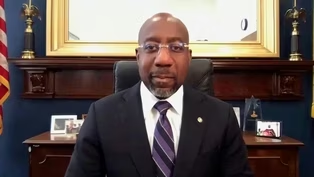
NewSen. Warnock Calls Out First Trillionaire, Supreme Court Voting Rights Ruling
Video has Closed Captions
Senator Raphael Warnock discusses his book "The Crooked Places Made Straight." (18m 14s)
Providing Support for PBS.org
Learn Moreabout PBS online sponsorship New Episode
- News and Public Affairs

Top journalists deliver compelling original analysis of the hour's headlines.

- News and Public Affairs

Today's top journalists discuss Washington's current political events and public affairs.






 New Episode
 New Episode
 New Episode
 New Episode
Support for PBS provided by: